

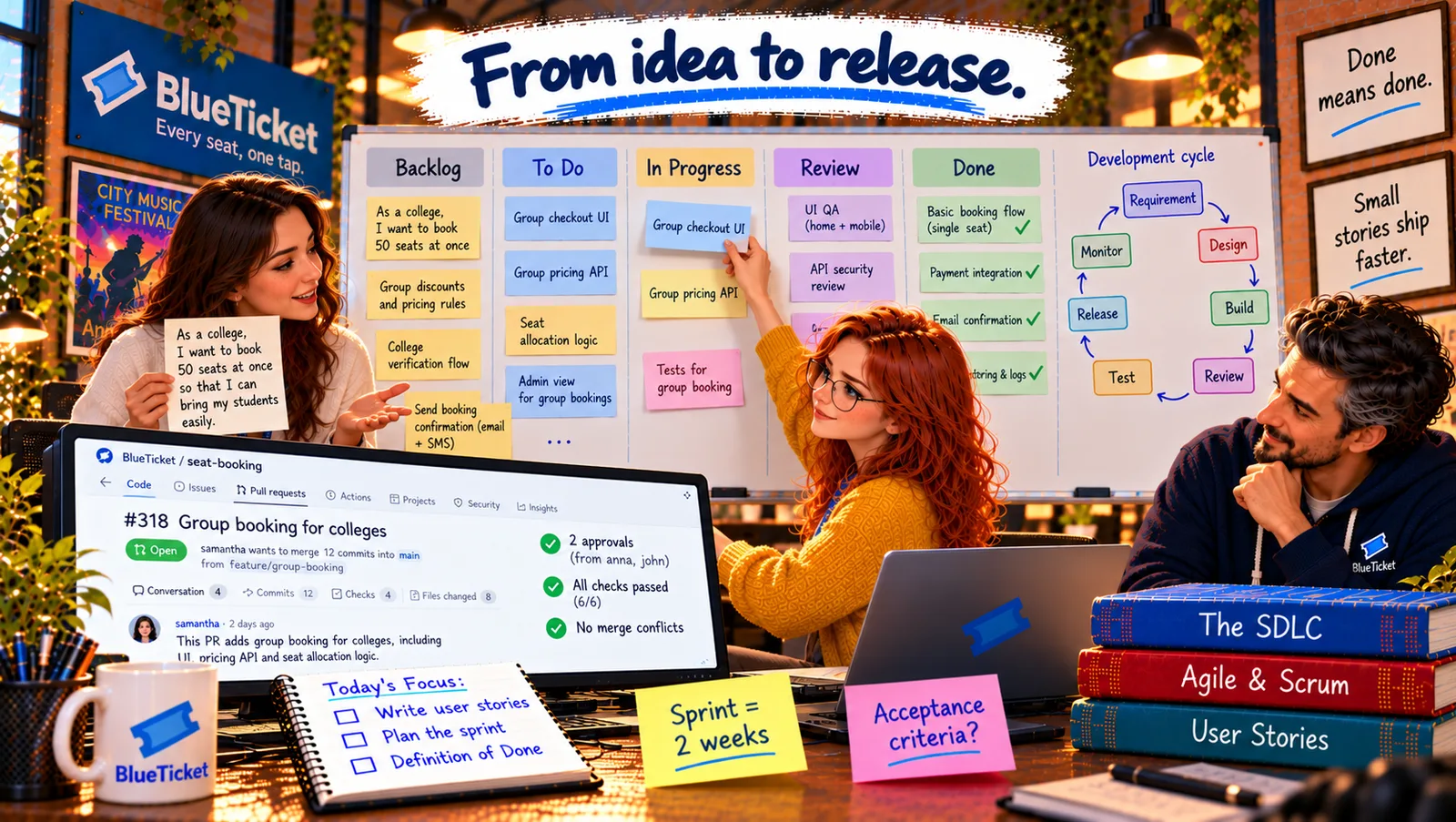
In this chapter
We'll learn the journey every piece of software takes — the software development lifecycle, from requirement and planning through design, development, testing and release to monitoring and maintenance — explained as building a house, and start it with a real feature request.
The Problem in Real Life
Month eight. Samantha comes back from a meeting with Northgate College — the college whose students couldn't reach BlueTicket in Act 11 — in a great mood. "They want to buy tickets for whole groups of students. Fifty at a time. And so will every college in the country, before festival season. That's six weeks from now. Can we build group booking for colleges?"
Anna is already opening her editor. John gently closes her laptop. "What does 'group booking' mean? Who pays? One payment or fifty? Do all fifty need names on day one? Is there a discount? If you start coding now, you'll build something. Probably not the thing she needs."
Most software that fails was built right — it was just the wrong thing.
John
Jumping Straight Into Code vs. Following a Lifecycle
Vague requests
"Group booking" can mean ten different things. Building the wrong one wastes weeks.
Many steps between idea and users
Code is only one step. Design, review, testing, release and support all matter.
A real deadline
Festival season won't wait. Planning decides what can realistically be ready in time.
The Software Development Lifecycle
The house-building analogy: nobody builds a house by buying bricks and starting to stack them. First you ask the family what they need (how many bedrooms? a garden?). Then you plan the budget and the schedule. An architect draws it. Builders build it. An inspector checks it. The family moves in. And for years afterwards, someone fixes the leaking roof and adds a room. Software follows the same journey. It's called the software development lifecycle, or SDLC.
- 1. Requirement — asking what the family needs: Find out exactly what problem to solve and for whom, by talking to the people who'll use it. The output is a clear list of what the software must do.
- 2. Planning — budget and schedule: decide what to build first, how long it might take, who works on it and what to leave for later. A six-week deadline means choosing what matters most.
- 3. Design — the architect's drawings: decide how it will work before writing code: what the screens look like, what new database tables are needed (Act 13), which API endpoints (Act 12), how it fits into the system diagram (Act 14).
- 4. Development — building the house: writing the code, in small pieces, on branches (Act 15), with a working local setup (Act 16).
- 5. Code review and testing — the inspector: teammates review the code; automated tests (Act 17) and people check that it works and nothing else broke.
- 6. Build and deployment — the family moves in: the code is packaged and released to production, where real users can use it (Act 19 goes deep into this).
- 7. Monitoring — watching how the house holds up: after release, watch dashboards, logs and errors (Act 06, Act 17) to see whether it works for real users.
- 8. Maintenance — fixing the roof, adding rooms: fix bugs that appear, improve things, update dependencies, adapt to new needs. For most software, this phase lasts the longest by far — years.
| SDLC phase | House version | Group booking example |
|---|---|---|
| Requirement | What does the family need? | Call with Northgate: 10–60 seats, one payment |
| Planning | Budget and schedule | Two sprints before festival season |
| Design | Architect's drawings | Group checkout screen, group_bookings table |
| Development | Building | Code on feature branches |
| Review & testing | The inspector | Pull request review, automated tests |
| Build & deploy | Moving in | Release to blueticket.example |
| Monitoring | Checking how it holds up | Watch group checkout errors and sales |
| Maintenance | Fixing the roof, new rooms | Bug fixes, invoices for colleges later |
| Question | Answer from Northgate |
|---|---|
| How many seats in one group? | Between 10 and 60 |
| Who pays? | The college — one payment for the whole group |
| Is there a discount? | 15% for 10 seats or more |
| Do we know every student's name at booking? | No — names added later, up to 48 hours before |
| What can wait until later? | Invoices for the accounts team |
The software development lifecycle — a loop
Requirement
what's needed, for whom
Planning
what first, how long
Design
screens, tables, APIs
Development
code on branches
Review & Testing
teammates + tests
Build & Deploy
release to users
Monitoring
is it working?
Maintenance
fixes, improvements
New requirements
what we learned starts the next loop
It's a loop, not a line: what you learn from monitoring and maintenance becomes new requirements, and the cycle starts again. Successful software goes around this loop hundreds of times.
Anna's requirement session: instead of coding, she spends an hour on a call with Northgate's events coordinator, with John and Samantha. Her notes become the requirements: (1) a college coordinator books 10 to 60 seats in one order; (2) one payment for the whole group; (3) a 15% group discount for 10 seats or more; (4) student names can be added later, up to 48 hours before the show, because the college often doesn't know who's going yet; (5) the seats are held for 15 minutes during checkout, like normal seats (Act 08). Things like invoices for the college's accounts team are useful, but can come later.
What she almost built: her first idea was "a page where each student buys their own ticket with a group code." Point (2) and point (4) would have made that useless. One hour of questions saved weeks of wrong work.
Key Takeaway
The SDLC is the journey every piece of software takes, like building a house: requirement (what's needed), planning, design, development, code review and testing, build and deployment, monitoring and maintenance — and then around again. Most failures start at the first step, so ask questions before writing code.
Why This Matters
Every company follows some version of the SDLC, even if they don't call it that. Knowing the phases helps you see where your work fits, ask the right questions at the right time, and understand why the team spends time on things that aren't code. And asking good requirement questions early is one of the fastest ways for a junior developer to earn trust.
The requirements are clear. But they're still one big pile of work, and festival season is six weeks away. Before planning how to build it, John wants Anna to see the second half of the journey — what happens to code after it's written.