

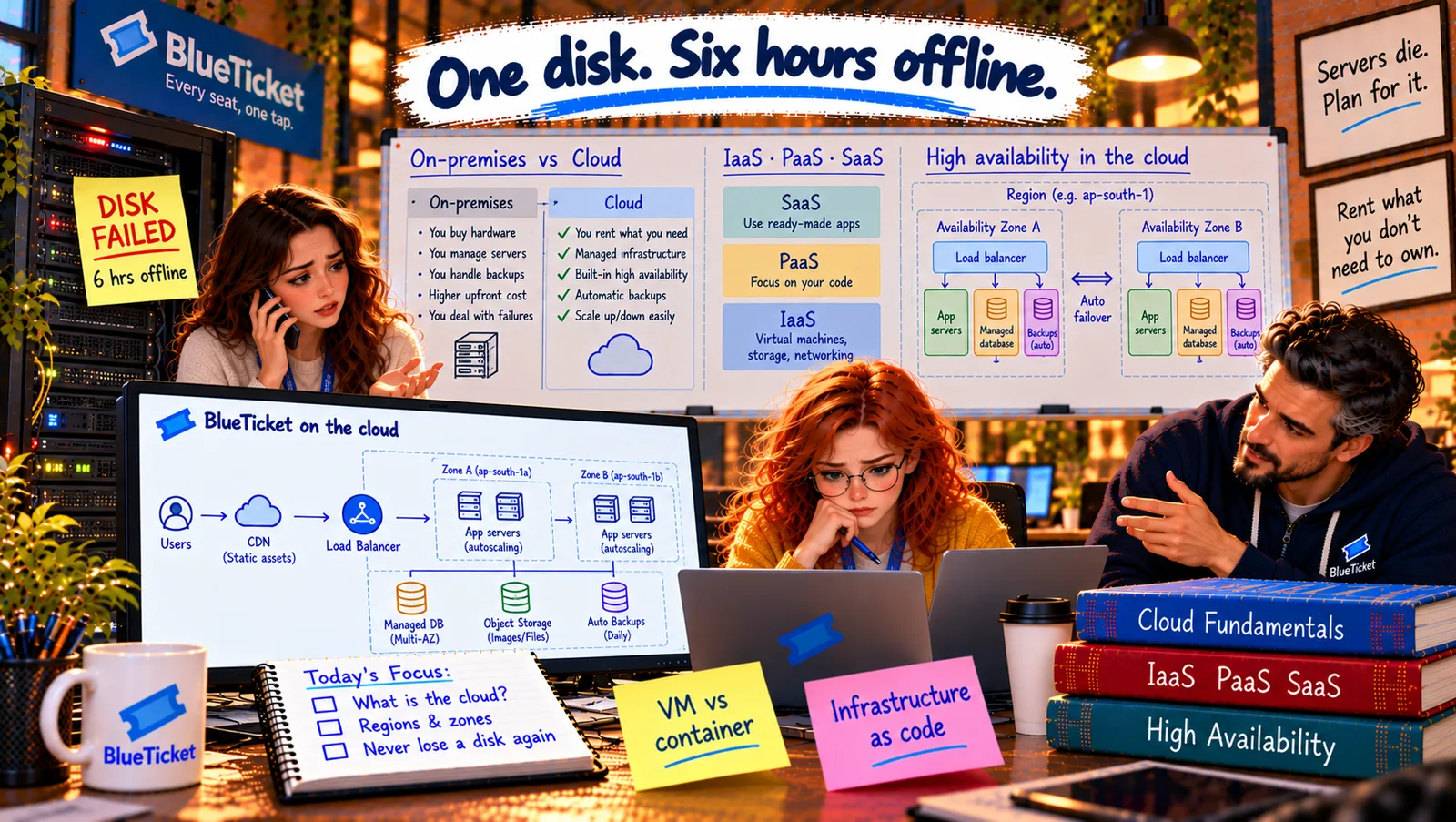
In this chapter
We'll learn what "the cloud" really is — renting computing power from someone else's huge data centres, on demand — why companies use it, and how it compares to running your own machines on-premises, explained as owning a car versus using taxis and car rentals.
The Problem in Real Life
Sunday, 9:05 AM. John's phone rings, then Anna's. blueticket.example is down. All of it. Not slow — gone. The hosting company that rents BlueTicket its servers posts a short message: "A storage system in our data centre has failed. Engineers are working on it."
That one storage system held the disks of every BlueTicket server: the four app servers, the main database, and even the database replica that was supposed to be the backup plan from Act 14. They all sat in the same building, on the same storage. One failure took everything.
It takes six hours. The hosting company replaces the hardware, John restores the database from the 3 AM backup, and the team re-enters 22 orders that happened after 3 AM by hand, from the payment provider's records. At 3:10 PM the site is back. Samantha has been on the phone with angry venues all day. On Monday morning she asks one question: "Can this happen again?"
I don't need to understand servers. I need to know this won't happen during festival season.
Samantha
Owning the Machines vs. Renting Computing Power on Demand
Hardware fails
Disks, power supplies and storage systems break. The only question is when.
Slow to grow
Ordering a new physical server took the hosting company three days. Sale Day needed more in minutes.
Everything in one building
Copies of data don't help much if every copy sits in the same place.
What Is Cloud Computing?
The car analogy: you can own a car: you buy it, insure it, repair it and park it, and it sits unused most of the day. Or you can use taxis and rental cars: you pay only when you travel, someone else does the repairs, and you can get a van for moving day and a small car for everyday trips. Running your own servers is owning a car. The cloud is the taxi and rental service for computers.
- Cloud computing — renting computers over the internet: cloud computing means using computing resources — servers, storage, databases, networks — that belong to a cloud provider, over the internet, when you need them, and paying for what you use. The biggest providers are Amazon Web Services (AWS), Microsoft Azure and Google Cloud. "The cloud" isn't in the sky: it's millions of real servers in huge data centres around the world.
- On demand — ready in minutes: you ask for a new server, a database or 10 TB of storage through a website or an API, and it's ready in minutes. When you don't need it any more, you delete it and stop paying.
- Elastic — bigger and smaller as needed: for Sale Day, add twenty servers for three hours; on a quiet Tuesday, run two. This is horizontal scaling from Act 14, but without buying a single machine.
- Pay as you go — no big purchase: instead of buying servers upfront, you pay by the hour, second or gigabyte. Good for starting small; but costs must be watched, because forgotten resources keep charging.
- Built for failure — many buildings: the big providers run many data centres in many places, designed so that one failing doesn't take everything down (chapter four). That's the part BlueTicket needed most on Sunday.
| Feature | On-premises (owning the car) | Cloud (taxis and rentals) |
|---|---|---|
| Getting a new server | Order, wait days or weeks | Minutes, through a website or API |
| Paying | Big purchase upfront | Pay for what you use |
| Hardware repairs | Your team | The provider |
| Scaling for Sale Day | Buy machines for the biggest day | Add servers for three hours |
| Control | Full | Shared with the provider |
| Spreading across buildings | Expensive — build or rent a second site | Built in, choose zones and regions |
| Time | What happened |
|---|---|
| 9:02 AM | Storage system in the hosting company's data centre fails |
| 9:05 AM | Every BlueTicket server is down — app servers, database and replica |
| 1:40 PM | Hosting company replaces the storage hardware |
| 1:45–3:00 PM | Database restored from the 3 AM backup |
| 3:10 PM | Site back online; 22 orders re-entered from payment records |
On-premises — owning the car: on-premises ("on-prem") means a company runs its own servers, in its own building or in a rented data-centre space. It gives full control and can be cheaper for large, steady workloads, but the company must buy hardware in advance, replace broken parts, handle power and cooling, and plan years ahead. Banks and governments often keep some systems on-prem for legal or control reasons.
Where BlueTicket was — a rented car, one garage: BlueTicket wasn't really on-prem or in the cloud. It rented fixed physical machines from a small hosting company in one data centre. New machines took days to arrive, and everything shared one building and one storage system. That's why one failure took everything down for six hours.
Anna's honest answer to Samantha, for now: "Yes, it can happen again, the way we're set up today. Every copy of our data lives in one building. The cloud doesn't make failures disappear, but it lets us spread our system across separate buildings cheaply. Give us two weeks and I'll be able to tell you exactly what can and can't take us down."
Key Takeaway
Cloud computing is renting computing resources — servers, storage, databases, networks — from a provider like AWS, Azure or Google Cloud, on demand and paying for what you use, like taxis and rental cars instead of owning a car. It's elastic and fast to change, and providers run many data centres so one failure needn't stop you. On-premises means running your own machines: full control, but you buy, repair and plan everything yourself.
Why This Matters
Most software you'll work on runs in the cloud, and job descriptions very often ask for basic cloud knowledge. Understanding what the cloud actually is — real data centres, rented on demand — and what it does and doesn't protect you from, helps you make sense of every deployment, cost discussion and architecture diagram you'll see.
"Move to the cloud" sounds like one decision. But John explains that there are really three very different ways to rent from a cloud provider — and choosing the right one for each part of BlueTicket decides how much work the team has to do itself.