

In this chapter
We'll learn how teams organise work today — Agile instead of one giant plan, and Scrum's sprints, backlog, roles and regular meetings — explained as building a skateboard, then a bicycle, then a car instead of waiting a year for a car.
The Problem in Real Life
Anna has a plan: "Six weeks. I'll build everything, then we'll test everything, then we'll release everything in week six." John raises an eyebrow. "And if, in week six, Northgate says it doesn't work the way they need? Or we find a big bug the day before festival season?"
"There's a better way. We build the smallest useful version first, put it in front of Northgate in two weeks, and learn. Then we build the next piece. That's how BlueTicket works. It has a name: Agile."
Don't build the car first. Build something that moves, then make it better.
John
One Giant Plan vs. Small Steps With Feedback
Late surprises
If users see the software only at the end, every misunderstanding is found when it's most expensive to fix.
Needs change
Over weeks and months, what users want changes. A plan fixed on day one can't follow.
Teams need a rhythm
Without a regular way to plan, talk and review, work drifts and problems hide.
Agile, Scrum, Sprints and the Backlog
The skateboard analogy: imagine someone needs to get across town. The old way: spend a year building a perfect car, and give them nothing until it's done — if it turns out they wanted something else, a whole year is wasted. The Agile way: give them a skateboard in week one (it moves!), a bicycle a few weeks later, then a motorbike, then a car. At every step they can travel, and at every step you learn what they really need.
- Waterfall — the one-giant-plan way: the phases of the SDLC happen once, in order, like water flowing down steps: all requirements, then all design, then all code, then all testing, then one big release. It works when needs are fixed and well understood (building a bridge), but software needs usually change.
- Agile — small loops with feedback: Agile is a way of working where the team goes around the whole SDLC loop in small pieces, again and again: build a small, working piece, show it to real users, learn, adjust, repeat. Working software early, and changing the plan when you learn something, are the core ideas.
- Scrum — one popular recipe for Agile: Scrum is the most common set of rules for working in an Agile way. Work happens in sprints: fixed periods, usually two weeks. Each sprint ends with something working that could be shown or released.
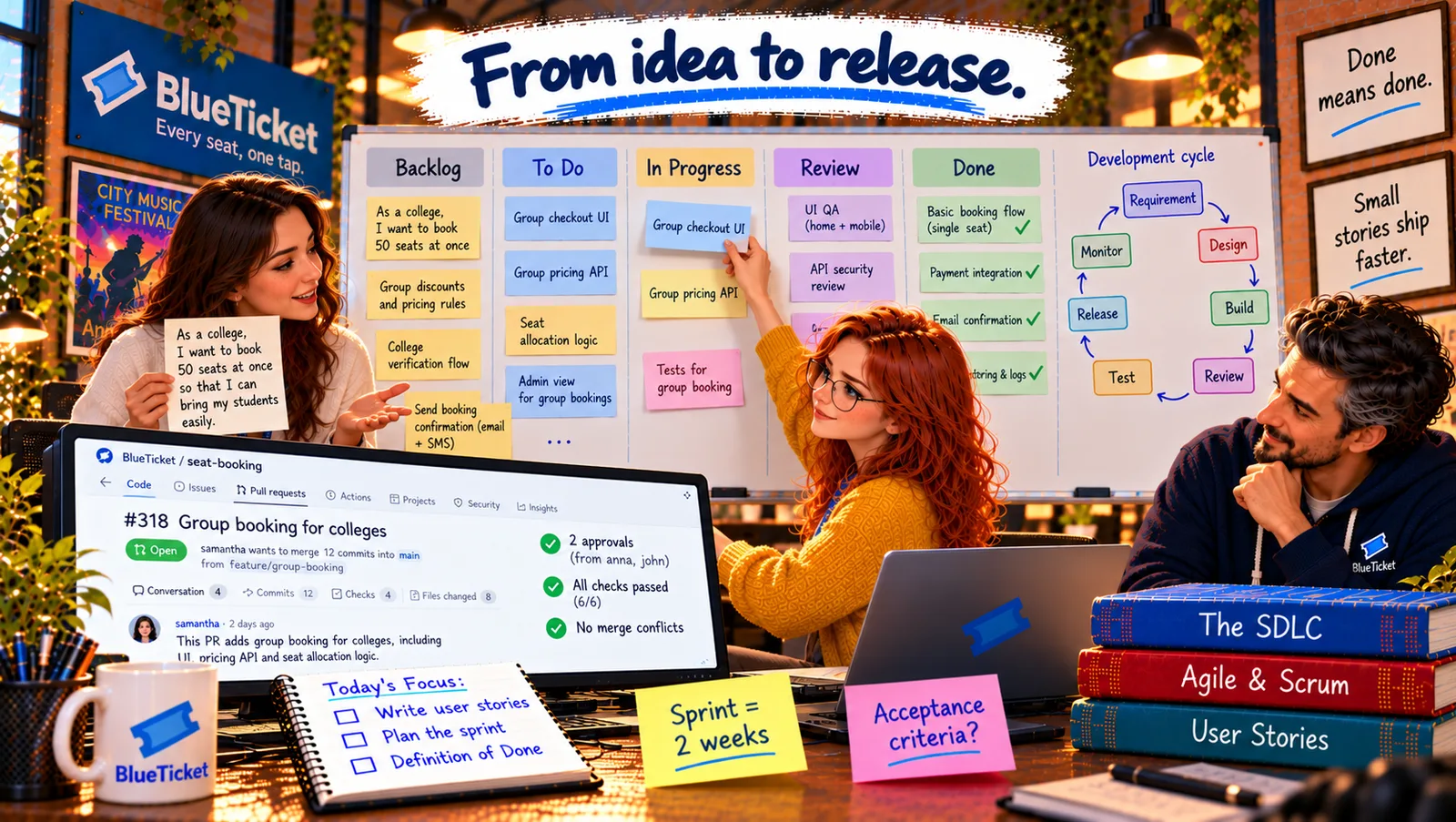
- Product backlog — the big to-do list: the backlog is the list of everything the product might need: features, improvements, bugs. It's kept in priority order — the most important things at the top. Samantha decides the order.
- Sprint backlog — this sprint's shopping list: at the start of each sprint, the team picks the top items they can realistically finish in two weeks. That's the sprint backlog. Once the sprint starts, it doesn't change unless something urgent happens.
- The three roles: the Product Owner decides what to build and in what order (Samantha at BlueTicket). The developers decide how and do the work (Anna, Liam, John). The Scrum Master keeps the process running smoothly and removes blockers (at BlueTicket, John wears this hat too).
| Feature | Waterfall | Agile |
|---|---|---|
| Plan | One big plan at the start | Re-planned every sprint |
| Users see it | At the end | Every few weeks |
| Change of needs | Expensive | Expected and welcome |
| Risk | Big surprises late | Small surprises early |
| Good for | Fixed, well-known needs | Most software products |
| Sprint | Goal | Includes |
|---|---|---|
| Sprint 1 (skateboard) | A coordinator can book a group | 10–60 seats, one payment, one confirmation |
| Sprint 2 (bicycle) | Groups are easy to manage | 15% discount, add names later, reminders, change seat count |
| Backlog (later) | Accounts team is happy | Invoices for colleges |
| Question | Anna's answer |
|---|---|
| What did I do yesterday? | Finished the group checkout API |
| What will I do today? | Connect the checkout screen to the API |
| Anything blocking me? | I need the payment test key for group orders |
One Scrum sprint (two weeks)
Product backlog
everything, in priority order
Sprint planning
pick the top items that fit
Sprint backlog
this sprint's work
Daily stand-up
15 minutes, every morning
Sprint review
demo working software
Retrospective
improve how we work
The four Scrum meetings — the team's rhythm: Sprint planning (start of the sprint): choose what goes into this sprint and how. Daily stand-up (15 minutes each morning, often literally standing): each person says what they did yesterday, what they'll do today, and whether anything is blocking them. Sprint review (end of the sprint): show the working software to the Product Owner and users — a demo — and collect feedback. Retrospective (after the review): the team talks about how it worked — what went well, what to improve next sprint.
The board — seeing work move: most teams track work on a board with columns: Backlog → To Do → In Progress → Review → Done. Each piece of work is a card that moves right. One look tells everyone where things stand. (Jira, Linear, GitHub Projects and Trello are common tools; some teams use a real whiteboard.)
Group booking in two sprints: at sprint planning, the team cuts the feature into a skateboard and a bicycle. Sprint 1 (the skateboard): a coordinator books 10–60 seats with one payment and gets one confirmation — the smallest version Northgate can actually use. Sprint 2 (the bicycle): the 15% group discount, adding student names later, and email reminders before the 48-hour deadline. Invoices go back into the backlog for later. At the end of sprint 1, Northgate tries it and says: "We need to be able to change the number of seats after booking." That goes into sprint 2's planning. With a six-week waterfall plan, they'd have found out in week six.
Key Takeaway
Agile means building in small working pieces and learning from real feedback — a skateboard, then a bicycle, then a car — instead of one giant waterfall plan. Scrum organises this into two-week sprints: a prioritised product backlog, a sprint backlog for the current sprint, three roles (Product Owner, developers, Scrum Master) and four meetings (planning, daily stand-up, review with a demo, retrospective). A board shows every card moving from Backlog to Done.
Why This Matters
Almost every software company you'll join works in some form of Agile, and most use Scrum or something close to it. From your first week, you'll be in stand-ups, sprint planning and reviews. Knowing why they exist — fast feedback, small risks, a steady rhythm — helps you take part well instead of just attending.
The sprints are planned. But "a coordinator books a group" is still too vague to put on a card and start coding. Work on the board has to be written in a special way — so that everyone knows exactly what "done" looks like for each card.