

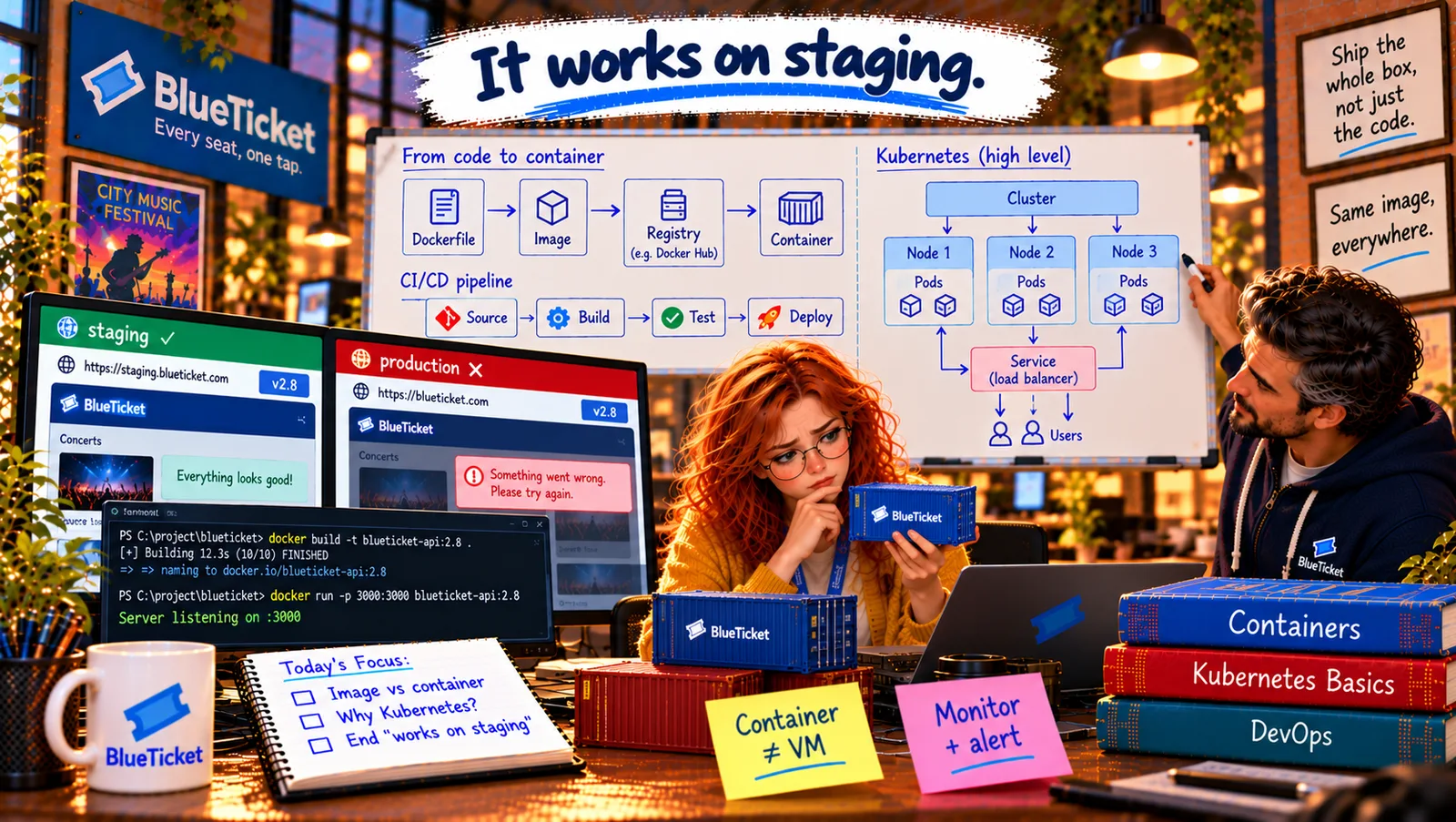
Reasoning Checkpoint
A design challenge, worked through in writing — no auto-grading, just a real attempt.
The Challenge
A new developer, Mia, joins BlueTicket next week. John asks Anna to write a one-page explanation: "How does a line of code I write become something running in production?" — using BlueTicket's web app as the example.
The web app has a Dockerfile, a pipeline, a private registry, and runs on the cloud's container platform (it would look the same in Kubernetes words). It reads settings from environment variables and talks to a managed database and Redis.
What Your Answer Needs
- Explain the journey in order: source code → Dockerfile → image → registry → container → cluster.
- Explain the difference between an image and a container in one or two sentences, with an analogy.
- Describe the pipeline stages and say why the same image goes to staging and production.
- Describe how the app runs in Kubernetes words: which Deployment, how many replicas, which Service, and what happens if a node dies.
- Explain where settings, secrets and data live, and why they're not inside the image.
- List the observability Mia should check after her first release, and explain what "you build it, you run it" means for her.
Stuck? A Few Hints
- Follow the chapters in order — they're the journey.
- Mia is a junior developer: use the ready-meal or harbour analogies if they help.
- Remember why the worker crashed on Tuesday — what would stop that now?
Before You Move On
If Mia could read your page and follow her first change all the way to production, you've understood the whole delivery chain — which many people never see end to end. The Docker and Kubernetes courses on this site take each step much deeper.