

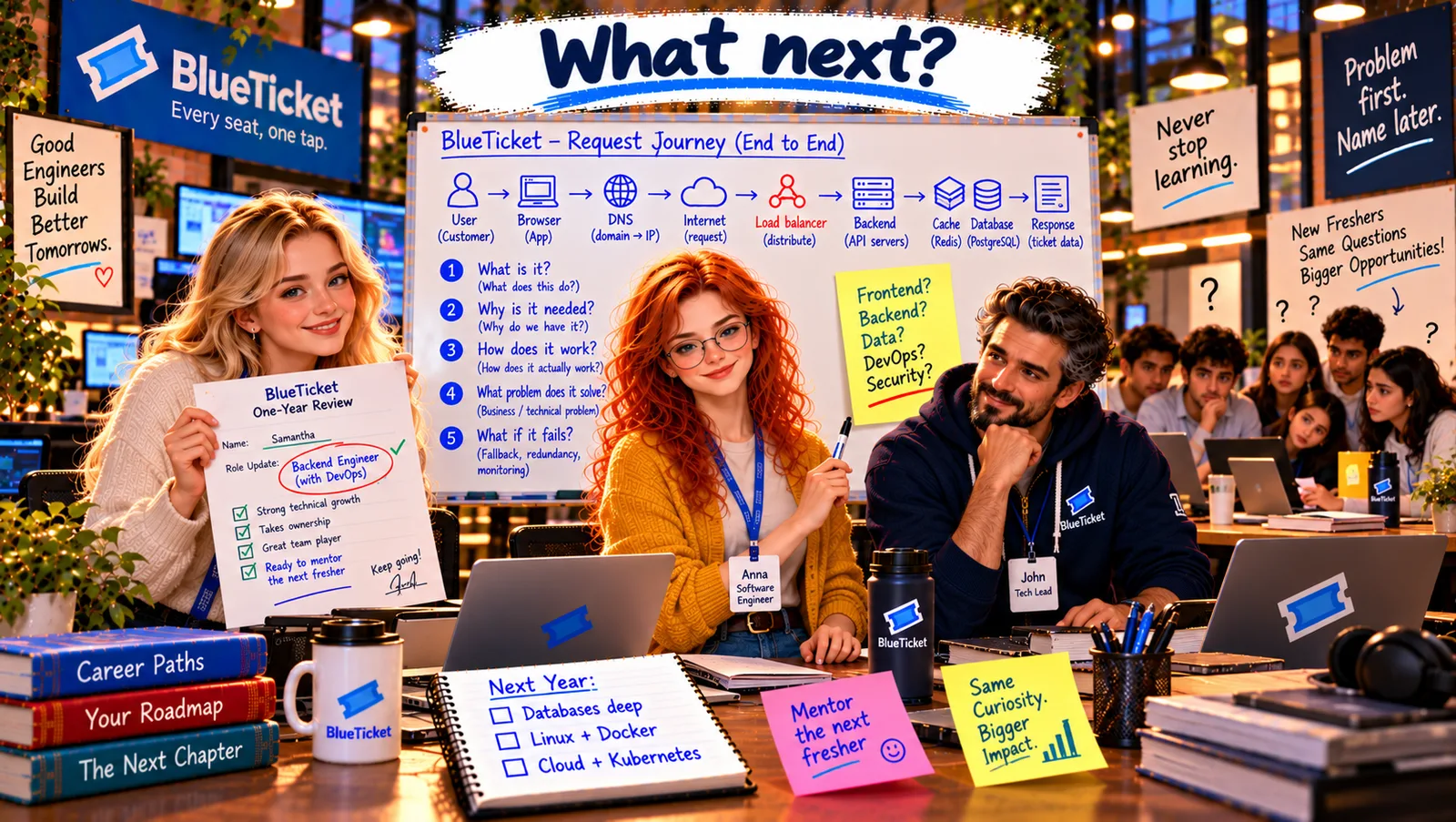
In this chapter
We'll learn how to show what you can do — a GitHub portfolio, a one-page technical resume with impact, and the main kinds of technical interviews (coding, system design basics, take-home, behavioural) with how to prepare and how to think out loud — explained as selling a house: the listing, the photos and the viewing.
The Problem in Real Life
Anna opens her old resume from a year ago: a list of college subjects, "hard-working team player", and a skills section with fourteen languages she'd used once. She winces.
John has an idea: "Rewrite it as if you were a stranger reading about Sale Day, the waitlist and the payment fix. And then let's do a mock interview. Liam can play the scary interviewer." Liam cracks his knuckles.
A year ago my resume said what I'd studied. Now it can say what I've done.
Anna
Listing What You Studied vs. Showing What You Built
Resumes that say nothing
Lists of skills and adjectives don't show what you can actually do.
Invisible work
Projects that live only on your laptop can't speak for you.
Interviews feel like exams
Freezing, guessing and staying silent hide what you really know.
GitHub Portfolio, Technical Resume and Interview Fundamentals
The house-selling analogy: selling a house needs three things. A listing that says clearly what's special about it — in a few lines, with real numbers (the resume). Photos and an open door, so people can see for themselves (the portfolio). And the viewing, where you show people around and answer their questions honestly (the interview). Each one gets people to the next.
- GitHub portfolio — the photos and open door: pin 2–4 of your best, finished projects (Act 27) rather than 30 tutorial copies. Each needs a strong README with a live link, screenshots, the stack, how to run it and what you'd improve (Acts 24, 27). A clean commit history, tests and CI badges show habits. A short profile README says who you are and what you're focusing on.
- Technical resume — the listing: one page for juniors. Top: name, links (GitHub, portfolio, LinkedIn). Then experience and projects written as impact bullets: action + what + result, with numbers where honest: "Designed and shipped a payment reconciliation job that recovered 212 orders during a 50,000-user on-sale" beats "Worked on payments." A short skills section grouped honestly ("Daily: TypeScript, Node.js, PostgreSQL. Familiar: Docker, Kubernetes concepts"). Education briefly. No photos, no long paragraphs, no skills you can't discuss.
- Getting past filters: many companies scan resumes for keywords from the advert. Use the advert's wording for things you really have ("REST APIs", "PostgreSQL", "CI/CD") — never list what you can't talk about (chapter three).
- Kinds of technical interviews: a screening call (who you are, why this role); coding interviews (solve a problem in code — data structures and complexity from Acts 08–09 matter here); system design basics for juniors ("how would you build a URL shortener?" — Acts 12–14, 26 are exactly this); take-home tasks (a small project — treat it like Act 27: tests, README); code review or debugging exercises (Acts 17, 24); and behavioural interviews (how you work with people).
- How to do well in technical interviews: ask clarifying questions first (Act 18's requirements); think out loud so the interviewer can follow and help; start with a simple working solution, then improve it; test it with examples and edge cases (Act 08); talk about trade-offs and complexity (Act 09); and when stuck, say what you're thinking — interviewers often give hints to people who communicate.
- Behavioural interviews — the STAR method: answer "tell me about a time..." with Situation, Task, Action, Result — a short, true story. Sale Day, the deploy that took checkout down (and the blameless review), the 31-comment PR — all great STAR stories. Have five or six ready.
- Your questions for them: chapter three's list: mentoring, on-call, how work is reviewed and deployed, what success looks like in six months. Interviews go both ways.
| Before | After |
|---|---|
| Worked on payments | Built a webhook reconciliation job that recovered 212 paid orders during a 50,000-user on-sale |
| Fixed bugs | Traced a production-only timezone bug to server configuration and added regression tests |
| Know Docker | Containerised and deployed an event waitlist app with CI, HTTPS and uptime monitoring |
| Good communication | Wrote the first README and setup guide for an undocumented legacy service |
| Interview | What it checks | Prepare with |
|---|---|---|
| Screening call | Motivation, communication | Your story in 2 minutes; why this role |
| Coding | Problem solving, data structures | Acts 08–09; practice problems, think aloud |
| System design (junior) | How systems fit together | Acts 12–14, 23, 26 |
| Take-home | Real-world habits | Act 27: tests, README, small commits |
| Debugging / code review | Reading code, finding bugs | Acts 17, 24, 25 |
| Behavioural | Teamwork, ownership, learning | 5–6 STAR stories |
The mock interview: Liam asks: "Design a simple waitlist for concerts." Anna asks how many users, whether people need accounts, and what happens when tickets open. She sketches the API and tables, mentions the unique constraint, then caching and a queue for notifications, then what could fail. Liam switches to behavioural: "Tell me about a mistake." She tells the Act 19 story with STAR — including the start-up check she added. Liam drops the scary voice. "Honestly? I'd hire you."
The new resume's first bullet: "Found the root cause of a Sale Day outage (expired TLS certificate on one load balancer node) in 4 minutes during a 50,000-user on-sale." Samantha reads it and says, half-joking: "Please don't send this anywhere."
Key Takeaway
Show what you can do like selling a house: a portfolio of 2–4 finished, documented, live projects (the photos and open door); a one-page resume of impact bullets with honest numbers and honest skills (the listing); and interviews where you ask clarifying questions, think out loud, start simple then improve, test edge cases and discuss trade-offs — plus STAR stories for behavioural questions and your own questions for them (the viewing).
Why This Matters
Skills only open doors when other people can see them. A focused portfolio, a resume full of real impact and a calm, communicative interview style turn a year of learning into opportunities — and every story in this course is a story you can now tell.
Resume, portfolio, interview stories — all ready, even if she isn't going anywhere. One chapter left: how to keep growing for the next ten years, not just the next one.