

In this chapter
We'll close the year with the habits that keep an engineer growing for decades — learning as compound interest, a long-term computer science foundation, communities, teaching others and looking after yourself — explained as tending a garden rather than building a wall.
The Problem in Real Life
The review is nearly over. Samantha has one last question, and it's not about technology. "A year ago, on your first day, you asked me what 'IT' even meant. What will you be asking a year from now?"
Anna thinks about it for a long moment. "Probably questions I don't know exist yet. That's the part I like now." John smiles: it's the best answer she could have given.
The goal was never to know everything. It was to never be afraid of what you don't know yet.
John
"I've Finished Learning" vs. Learning as a Lifelong Habit
The field keeps moving
New tools, languages and AI change how software is built every year.
Busy years ahead
Work, life and deadlines will always compete with learning time.
Learning alone is hard
Without people around you, motivation and feedback fade.
Continuous Learning and a Long-Term Computer Science Foundation
The garden analogy: a wall is built once and then it's done. A garden is never done: you tend it a little every week, some plants grow slowly for years, you pull weeds, try new seeds, and share cuttings with neighbours. A career in technology is a garden, not a wall.
- Compound interest of learning: an hour a week doesn't feel like much. Over five years it's 250 hours of deliberate practice — on top of everything you learn at work. Small, steady effort compounds, like money in a savings account (Act 24's habits: notes, struggle-then-ask, building).
- The long-term computer science foundation: the slow-growing trees in the garden: data structures and algorithms (Act 09), operating systems (Acts 05, 10), networks (Acts 11, 12), databases (Act 13), distributed systems (Acts 14, 23, 26), security (Act 22). Tools sit on top of these and change; these change slowly. Return to them every year or two, a little deeper each time — the specialist courses on BizTechLab are built for exactly that.
- AI as a learning partner, not a replacement (Act 16): AI assistants can explain, quiz you and review your code. Use them to learn faster — but keep understanding everything you ship, and keep practising the fundamentals, because judging whether the AI is right needs exactly that knowledge.
- Communities — sharing cuttings with neighbours: local meetups, online communities, open-source projects, colleagues. You learn faster with others, find mentors, and later become one.
- Teach what you learn: write the TIL post, give the team demo, mentor the next fresher (Act 24). Teaching is the fastest way to find the gaps in your own understanding.
- Look after yourself: sleep, breaks and a life outside screens are part of a long career. Burnout stops learning completely; a sustainable pace keeps it going for decades.
| Foundation | Started in | Go deeper with |
|---|---|---|
| Data structures and algorithms | Acts 08, 09 | Practice problems, a DSA course |
| Operating systems and memory | Acts 05, 06, 10 | Linux and Operating Systems courses (planned) |
| Networks | Acts 11, 12 | Networking Fundamentals (planned) |
| Databases | Act 13 | Relational and Non-Relational Databases (live) |
| Storage | Acts 02, 13, 20 | Storage Systems (live) |
| Distributed systems | Acts 14, 23, 26 | System Design Fundamentals (planned) |
| Security | Act 22 | Security-focused courses and practice |
| Habit | Garden version | How often |
|---|---|---|
| Deliberate learning | Weekly tending | A few hours a week |
| Revisit fundamentals | The slow-growing trees | Every year or two |
| Build projects | Trying new seeds | Every few months |
| Teach and write | Sharing cuttings | Monthly |
| Rest | Letting the soil recover | Always |
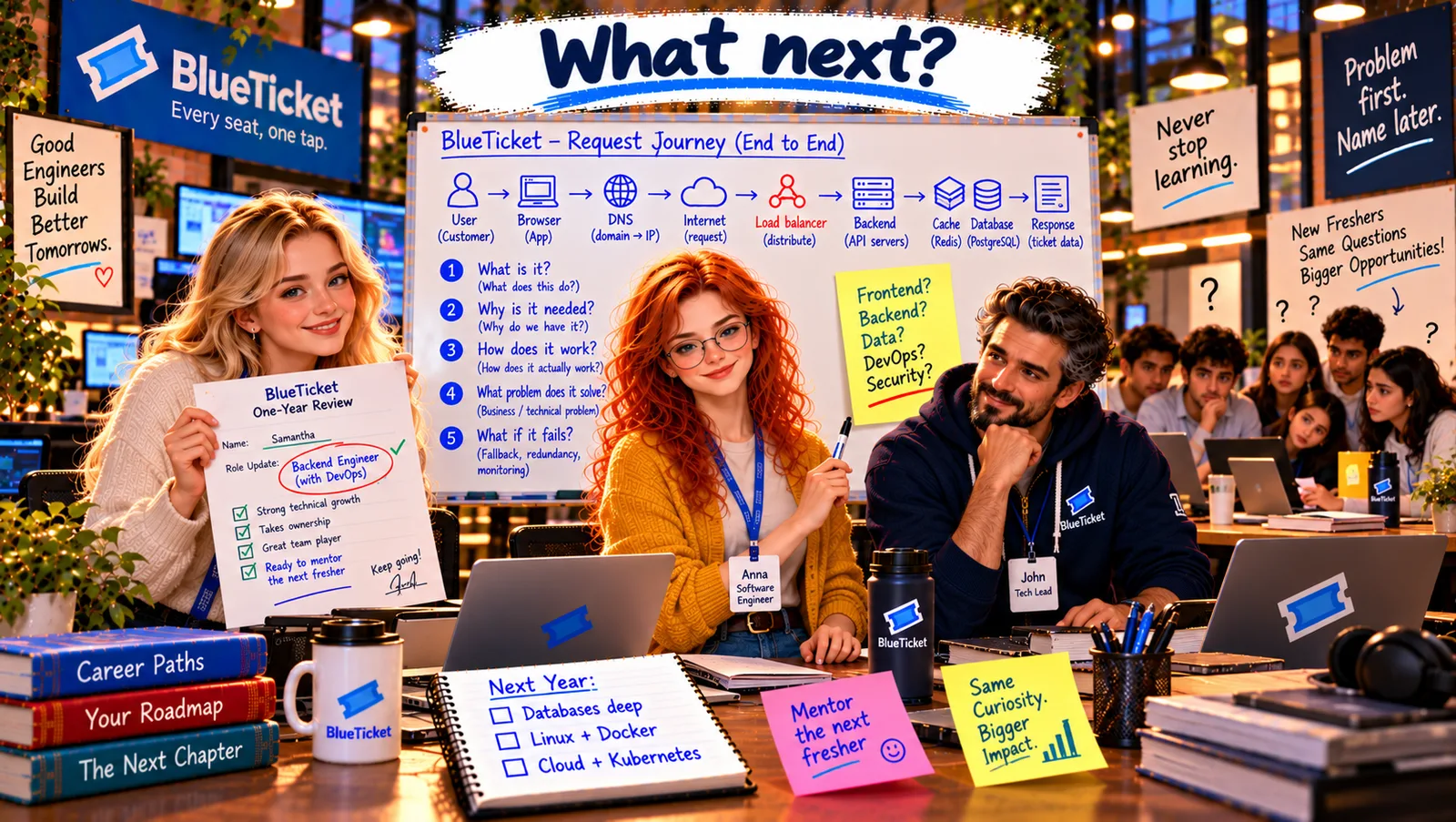
The end of the review: Samantha signs the form: Backend Engineer (with DevOps). John adds one line in the comments box: "Ready to mentor the next fresher." Anna reads it twice. "Next fresher?" Samantha smiles. "Monday. Five of them."
Key Takeaway
A tech career is a garden, not a wall: small, steady learning compounds over years; the computer science foundation — data structures, operating systems, networks, databases, distributed systems, security — grows slowly and lasts, so revisit it deeper every year or two; use AI to learn faster without outsourcing understanding; learn with communities; teach what you learn; and protect a sustainable pace.
Why This Matters
The technology you use in five years may not exist today, but the habits and foundations in this course will still apply. Engineers who keep learning steadily, revisit fundamentals and share what they know are the ones who grow into seniors, leads and mentors — and enjoy the journey.
Monday morning. Five freshers sit in the meeting room, looking exactly as lost as Anna did a year ago. John hands her the whiteboard marker. That's the final capstone — for her, and for you.