

Reasoning Checkpoint
A design challenge, worked through in writing — no auto-grading, just a real attempt.
The Challenge
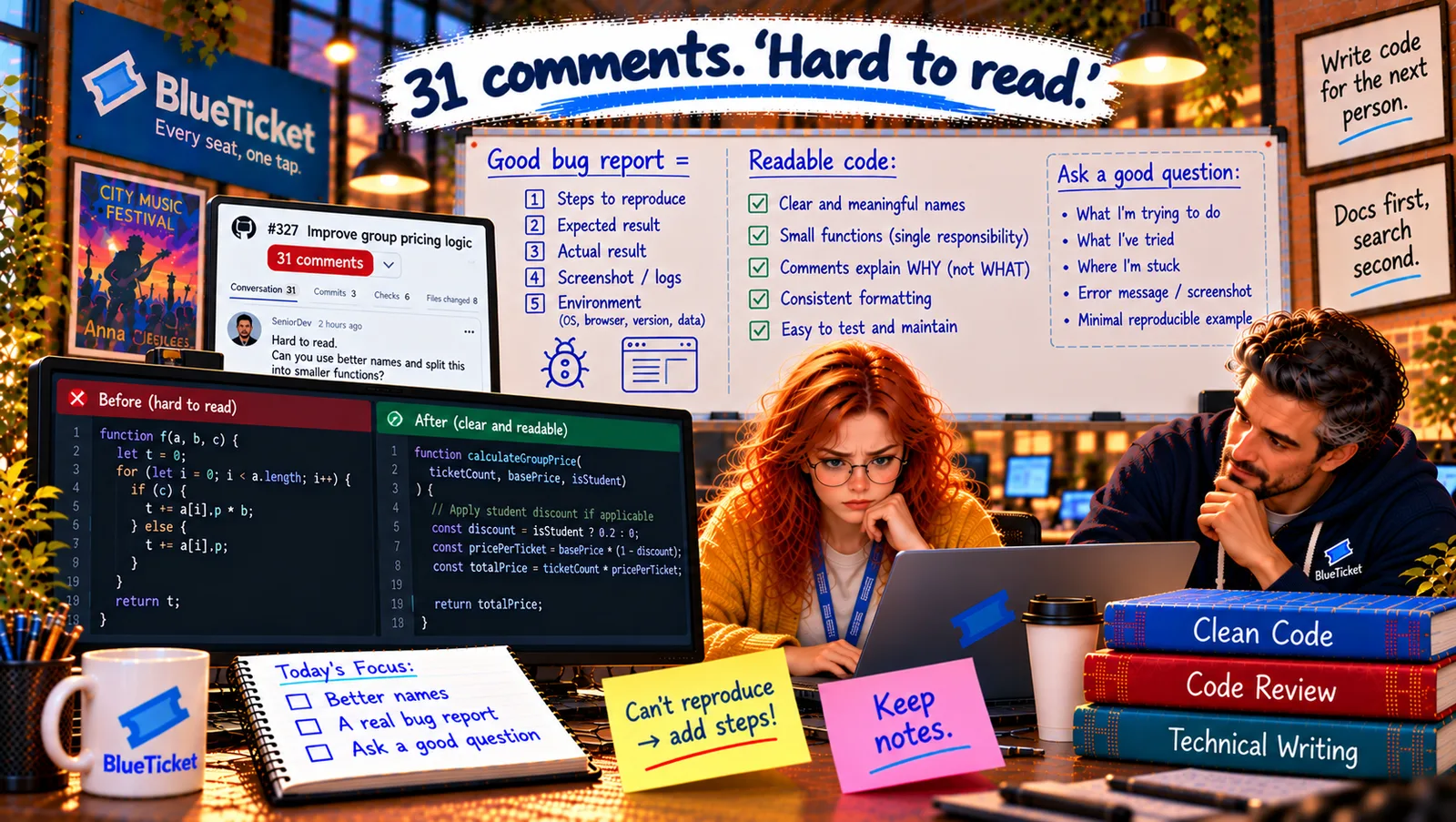
John gives Anna two real messages from BlueTicket's history and asks her to rewrite both so the reader could act on them immediately.
Bad bug report (issue #498): "Refund not working!!! Customer is angry. Please fix urgently." Extra facts you can use: it happened to a fan named Grace Miller on order ord_2231 yesterday at 14:05 in production; the refund button in the admin panel showed a spinner forever; the network tab showed POST /v1/refunds returning 422 with code amount_exceeds_charge; the order total was 120.00 and the admin typed 120 in the amount box; refunds of smaller amounts work.
Bad PR description (PR #503): "fixed stuff" — 640 lines changed. Extra facts: it fixes issue #498 — the refunds code added the 1.50 booking fee on top of the amount typed, so a full refund of 120.00 was sent as 121.50, more than the original charge; it also renames amt to amountInCents everywhere in the refunds code, adds tests for full and partial refunds, and updates the refunds runbook.
What Your Rewrites Need
- Rewrite the bug report with a clear title, steps to reproduce, expected vs actual result, environment, evidence, frequency and impact.
- Rewrite the PR description with a clear title, what changed and why, a link to the issue, how to test it, and anything reviewers should look at carefully.
- Say whether the 640-line PR should be split, and if so how.
- Write one review comment you'd leave on the PR (blocking or nit), worded kindly and specifically.
Stuck? A Few Hints
- Write each one for its reader: the developer who has to reproduce the bug; the reviewer who has to understand the change.
- The facts are given to you — your job is to put them in the right order and the right place.
- Renaming things across many files and fixing a bug are two different ideas.
Before You Move On
Notice that you didn't need any new technical knowledge — only the facts, put in the order your reader needs them. That's most of professional communication. If a stranger could act on your rewrites without asking you a single question, you've got it.