

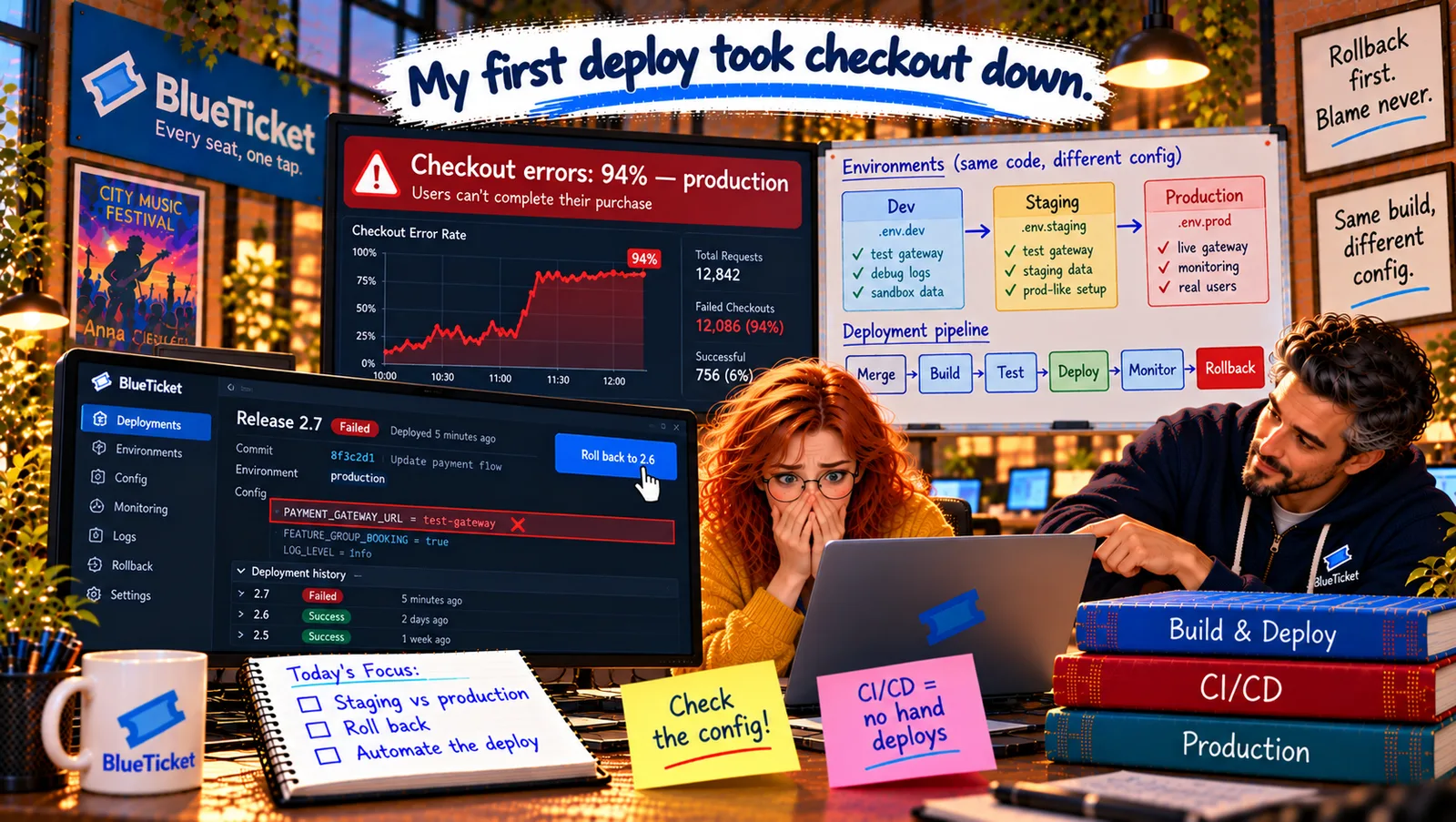
Reasoning Checkpoint
A design challenge, worked through in writing — no auto-grading, just a real attempt.
The Challenge
Samantha is presenting BlueTicket's engineering process to a new investor and asks Anna to explain, on one page, how a change travels from a merged pull request to production — and how the team gets back if something goes wrong.
BlueTicket has a staging and a production environment, four app servers behind a load balancer and reverse proxy, a monitoring tool, and wants a person to approve each production release.
What Your Answer Needs
- List the pipeline's steps in order, from a push to a pull request until the release is live in production.
- Say where the build artifact is made, and why the same one is used for staging and production.
- Explain where each environment's settings and secrets live, and how the 4:10 PM incident is now prevented.
- Name the deployment strategy for production and what protects fans during it.
- Name at least three metrics to watch after a release, with an alert for one of them.
- Describe the rollback: who or what triggers it, what exactly gets deployed, and what happens afterwards.
- Say whether this is continuous delivery or continuous deployment, and why.
Stuck? A Few Hints
- Follow the chapters in order: environments, artifact and config, servers, front door, monitoring, pipeline.
- The investor isn't technical — use one analogy if it helps.
- Rollback isn't the end: what does the team do the next morning?
Before You Move On
If your page explains the path and the way back clearly enough for a non-technical investor, you understand deployment better than many people who do it every day. The way back — rollback and a blameless review — is the part most people forget, and the part that matters most on a bad day.