

In this chapter
We'll learn what a network is, how small networks join into the internet, the difference between a LAN and a WAN, and why the internet and the web are not the same thing — using the postal system as our picture.
The Problem in Real Life
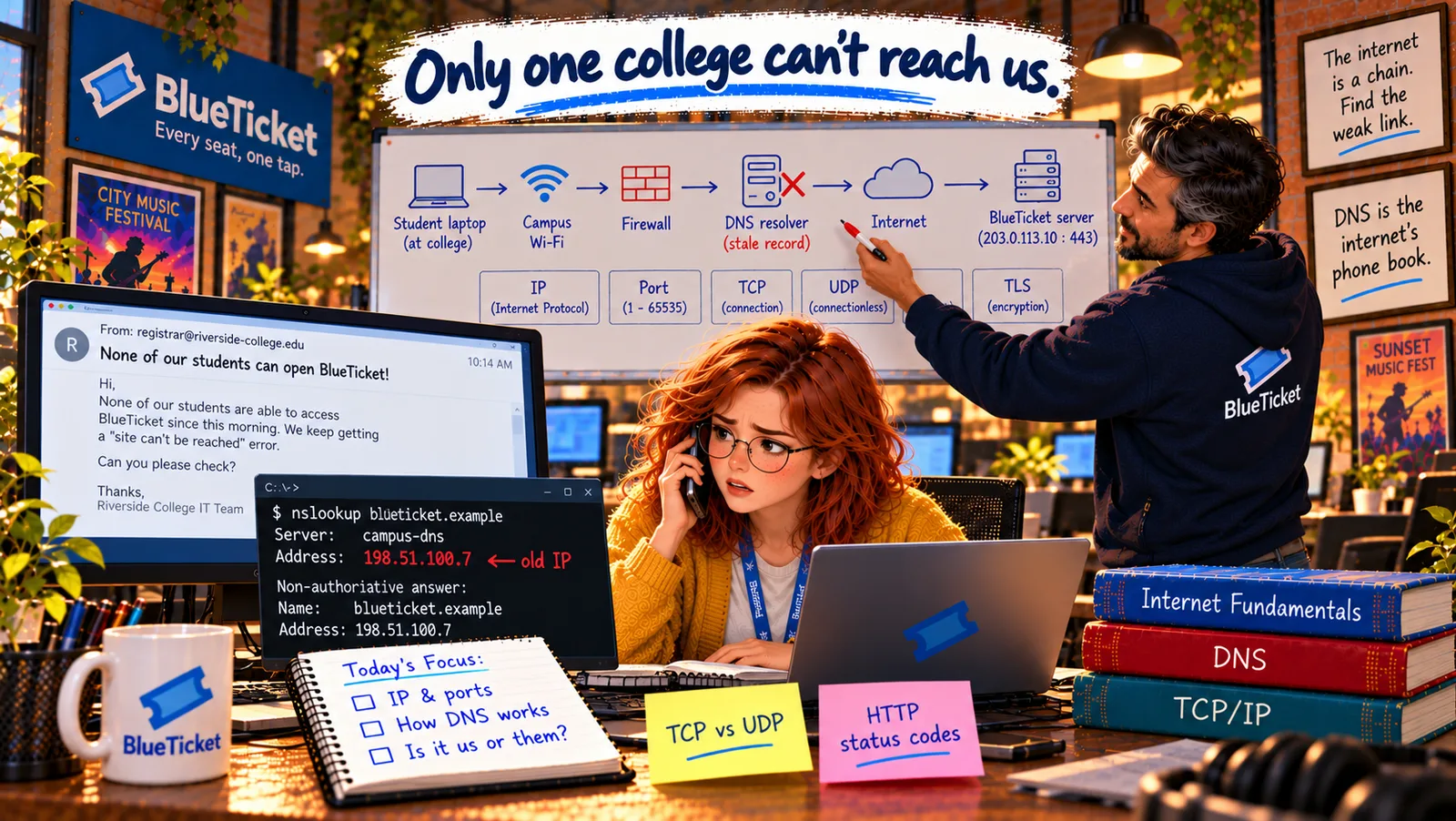
Week eleven. Ticket sales for the Northgate College spring fest open at noon. At 12:05, a message arrives from the college's student union: "None of our students can open BlueTicket! It just keeps loading."
Anna opens the site on her laptop. It works. On her phone over mobile data — works. She asks a friend across town to try — works. Samantha checks the dashboard: sales from everywhere else are normal. Only students on the Northgate campus are stuck.
"Our site is fine," Anna says, confused. "So how can it be broken for one college?"
When it works everywhere except one place, the problem is usually on the road between us and them — not in our app.
John
"The Site Is Down" vs. "The Road to the Site Is Broken"
Works here, fails there
The same website can be reachable from one place and unreachable from another.
A long chain of networks
Between a student's laptop and BlueTicket's server, data passes through many separate networks.
Internet vs. web
People use the words as if they mean the same thing. They don't — and the difference helps you debug.
Networks and the Internet
John draws a little house on the whiteboard, then a post office, then a big sorting centre. "Let's start with something you already understand perfectly: sending a letter."
The postal system analogy: when you post a letter to a friend in another country, it doesn't fly there directly. It goes from your house to the local post office, to a regional sorting centre, onto a plane, into another country's sorting centre, to their local post office, and finally to your friend's door. Many separate offices, each run by different people, all following the same rules for addresses and envelopes. The internet works the same way — just with data instead of letters, and in milliseconds instead of days.
Network — computers that can talk to each other: a network is two or more devices connected so they can share data. Your phone and laptop on your home Wi-Fi form a small network. So do all the computers in BlueTicket's office. Like a building's internal mail room, a network lets devices pass messages to each other.
- LAN (Local Area Network) — one building's mail room: a network that covers a small area — a home, an office, a school campus. Everything is close, fast and usually owned by one organisation. The Northgate campus Wi-Fi is a LAN. So is BlueTicket's office network.
- WAN (Wide Area Network) — the national postal service: a network that covers a large area — cities, countries, the world. It connects many LANs together, usually using cables and links owned by big telecom companies. A company with offices in three cities might connect them with a WAN.
- The internet — every postal service in the world, agreeing on the same rules: the internet is a network of networks: millions of LANs and WANs owned by different companies, universities, homes and governments, all connected and all following the same set of rules (called protocols) for addresses and messages. Nobody owns the whole internet — just like no single country owns the world's postal system.
- Internet service provider (ISP) — your local post office: the company that connects your home or campus to the rest of the internet. Northgate College's campus network connects to the internet through its ISP.
| Postal system | Internet | Example |
|---|---|---|
| One building's mail room | LAN | Campus Wi-Fi, office network |
| Your local post office | ISP | The company that connects your home |
| National and international post | WANs and the internet backbone | Telecom networks between cities and countries |
| Every country's post following the same address rules | Internet protocols | IP, TCP, DNS, HTTP — this Act |
| A letter | A message of data | A request for a web page |
| Feature | LAN | WAN |
|---|---|---|
| Covers | A home, office or campus | Cities, countries, the world |
| Owned by | Usually one organisation | Usually telecom companies |
| Speed | Very fast | Slower over long distances |
| Example | Northgate's campus Wi-Fi | Links between a company's offices in three cities |
| The internet carries... | Is it the web? |
|---|---|
| Web pages in a browser | Yes |
| No | |
| Video calls | No |
| Online games | No |
| App and system updates | No |
A Northgate student's request, from campus to BlueTicket
Student's laptop
on the campus Wi-Fi
Campus LAN
Northgate's own network — one building's mail room
College's ISP
the local post office to the outside world
The internet
many WANs owned by many companies
BlueTicket's server
answers the request
The internet vs. the web — the roads vs. one kind of truck: the internet is the network itself — the roads, sorting centres and rules. The World Wide Web is just one service that travels on it: web pages and websites, viewed in a browser. Email, video calls, online games, app updates and file transfers also travel on the internet, but they're not "the web." When someone says "the internet is down," they often mean "this website won't load" — which could be a problem with just the web part, just one site, or the road in between.
Back to Northgate: Anna draws the journey of a student's request. It starts on a laptop on the campus LAN, goes through the college's equipment, out to the college's ISP, across the internet's WANs, and finally reaches BlueTicket's server. The request from everyone else takes a different road and arrives fine. So somewhere on the Northgate part of the road, something is different. To find it, she'll need to understand each stop along the way — starting with who is asking and who is answering.
Key Takeaway
A network is devices connected so they can share data; a LAN covers one place like a home or campus, a WAN covers long distances, and the internet is a network of networks, all following the same rules — like the world's postal services. The web is just one service that travels on the internet, alongside email, video calls and more.
Why This Matters
Almost every software product depends on the network, and almost every "it's down" report starts with the same question: is it our app, or the road to it? Being able to picture the chain — device, local network, ISP, internet, server — is the first step in every network investigation. The Networking Fundamentals course goes much deeper; this Act gives you the map.
Anna has the map of the road. Next she needs to understand the two ends of it: the student's laptop asking for a page, and BlueTicket's server answering.