

In this chapter
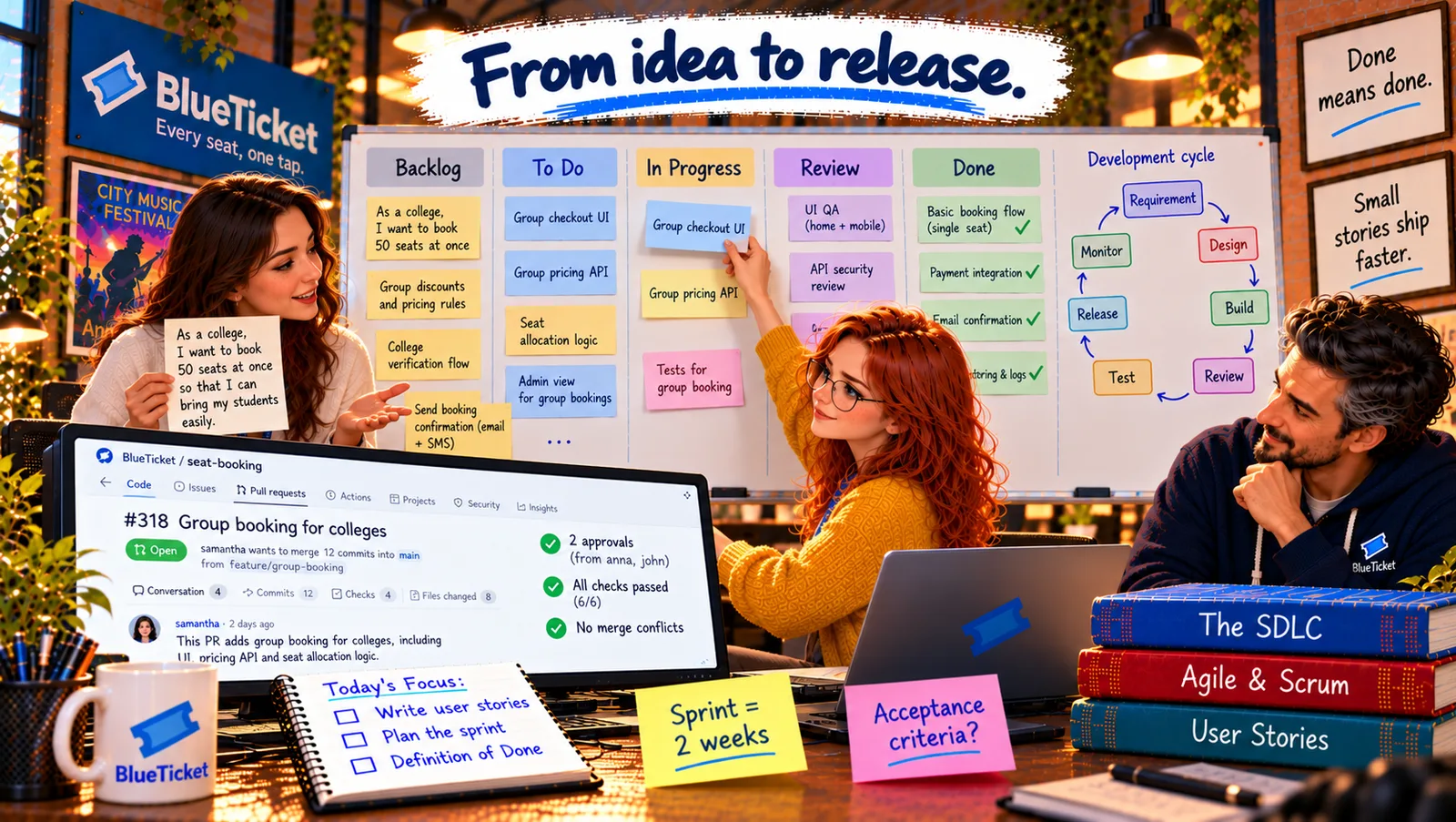
We'll learn how work is written down so everyone understands it — user stories with acceptance criteria, tasks and bug tickets — explained as a restaurant order, the kitchen jobs it creates and a customer's complaint, and split group booking into stories that fit a sprint.
The Problem in Real Life
Anna writes her first card for the board: "Build group booking." John reads it and hands it back. "How will you know when it's done? What does a coordinator click? What happens with 61 seats? If you get hit by a bus tomorrow, could Liam pick this up?"
"Cards aren't notes to yourself. They're promises written so that anyone — the developer, the tester, Samantha — understands the same thing."
If you can't say how to test it, you don't know what you're building yet.
John
"Build Group Booking" vs. Work Anyone Can Pick Up
Vague cards
"Build group booking" means something different to every reader.
Cards too big
A card that takes three weeks can't fit a two-week sprint, and hides problems until the end.
No clear finish line
Without clear conditions, "done" becomes an argument instead of a fact.
User Stories, Acceptance Criteria, Tasks and Bugs
The restaurant order analogy: a customer's wish — "a vegetarian lasagne, no onions, by 8 o'clock" — is written on an order ticket. The kitchen turns that one order into jobs: make the sauce, cook the pasta, bake it, plate it. And if the customer sends it back cold, that's a complaint to deal with. Work on a software team comes in the same three shapes: user stories, tasks and bugs.
- User story — the customer's order: a user story describes something a user wants, from their point of view, in one sentence: As a [type of user], I want [something], so that [reason]. Example: "As a college coordinator, I want to book up to 60 seats in one order, so that I don't have to collect 60 separate payments from students." It says who, what and why — but not how. The how is the developers' job.
- Acceptance criteria — how we'll know it's right: a story comes with a short list of acceptance criteria: conditions that must be true for the story to be accepted. A popular way to write them is Given / When / Then: "Given I'm a coordinator, when I choose 61 seats, then I see 'Groups can book up to 60 seats' and can't continue." Each one can be turned straight into a test (Act 17).
- Small stories — one bite at a time: a good story is small enough to finish in a few days, and still delivers something a user can see. "Build group booking" is a whole meal. Split it by user steps (choose seats → pay → get confirmation → add names), or by simple first, extras later (booking without discount first, discount next).
- Task — the kitchen's jobs: a task is a piece of technical work needed to finish a story — not something a user sees directly. The story "book up to 60 seats in one order" might become tasks like: create the
group_bookingstable (Act 13), build the group checkout API endpoint (Act 12), build the group checkout screen, write tests. - Bug — the complaint: a bug ticket is something that doesn't work as it should — written exactly like Act 17: steps, expected, actual. Bugs go into the same backlog as stories, and Samantha prioritises them alongside new features.
- Estimates — measuring the size of each bite: Teams often estimate how big each story is, so they know how much fits in a sprint. Some use hours or days; many use story points — a relative size (1, 2, 3, 5, 8...) comparing stories to each other, not to the clock. A story of 13 or more usually means "split me".
| Type | Restaurant version | Group booking example |
|---|---|---|
| User story | The customer's order | As a coordinator, I want to book up to 60 seats in one order... |
| Task | A kitchen job | Build POST /api/group-bookings |
| Bug | A complaint | Confirmation email lists only the first 20 seats |
| Story | Sprint | Size (points) |
|---|---|---|
| Book 10–60 seats in one order with one payment | 1 | 8 |
| Get one confirmation email with every seat | 1 | 3 |
| 15% discount for 10 or more seats | 2 | 3 |
| Add student names later, up to 48 hours before | 2 | 5 |
| Change the number of seats after booking | 2 | 5 |
| Invoice for the college's accounts team | Later | 5 |
| Given | When | Then |
|---|---|---|
| I'm a coordinator choosing 10–60 seats | I check out | I pay once and get one confirmation |
| I choose fewer than 10 seats | I check out | I see the normal checkout |
| I choose 61 seats | I try to continue | I see "Groups can book up to 60 seats" |
| My group has 30 seats in checkout | 15 minutes pass without paying | All 30 seats are released |
Anna's rewrite: "Build group booking" becomes several stories. Here's the first one in full. Story: As a college coordinator, I want to book between 10 and 60 seats in one order, so that I can pay for the whole group at once. Acceptance criteria: (1) Given I choose 10 to 60 seats, when I check out, then I pay once for all of them and get one confirmation email with all the seat numbers. (2) Given I choose fewer than 10 seats, then I see the normal checkout. (3) Given I choose more than 60, then I see a message and can't continue. (4) Given I'm checking out, then all the seats are held for 15 minutes, like normal seats.
And its tasks: add the group_bookings table; build POST /api/group-bookings; build the group checkout screen; extend the seat hold to many seats in one transaction (Act 13); write unit and integration tests for each criterion. Liam reads the card and says, "I could start this right now." That's the test of a good card.
Key Takeaway
Work comes in three shapes, like a restaurant: user stories (the customer's order: As a..., I want..., so that...), tasks (the kitchen's technical jobs) and bugs (complaints, written as steps, expected and actual). Every story has acceptance criteria — often Given / When / Then — that say exactly when it's right and turn straight into tests. Keep stories small enough to finish in a few days; split anything bigger.
Why This Matters
Clear stories, tasks and bug tickets are how a team agrees on what to build without endless meetings. Developers who can split a big request into small stories and write testable acceptance criteria become trusted quickly — and in interviews, "how would you break this feature down?" is a very common question.
The cards are on the board and the sprint begins. Days later, Anna's first card moves to the Review column. Her code works on her laptop. But at BlueTicket, "it works on my laptop" is far from "done".