

In this chapter
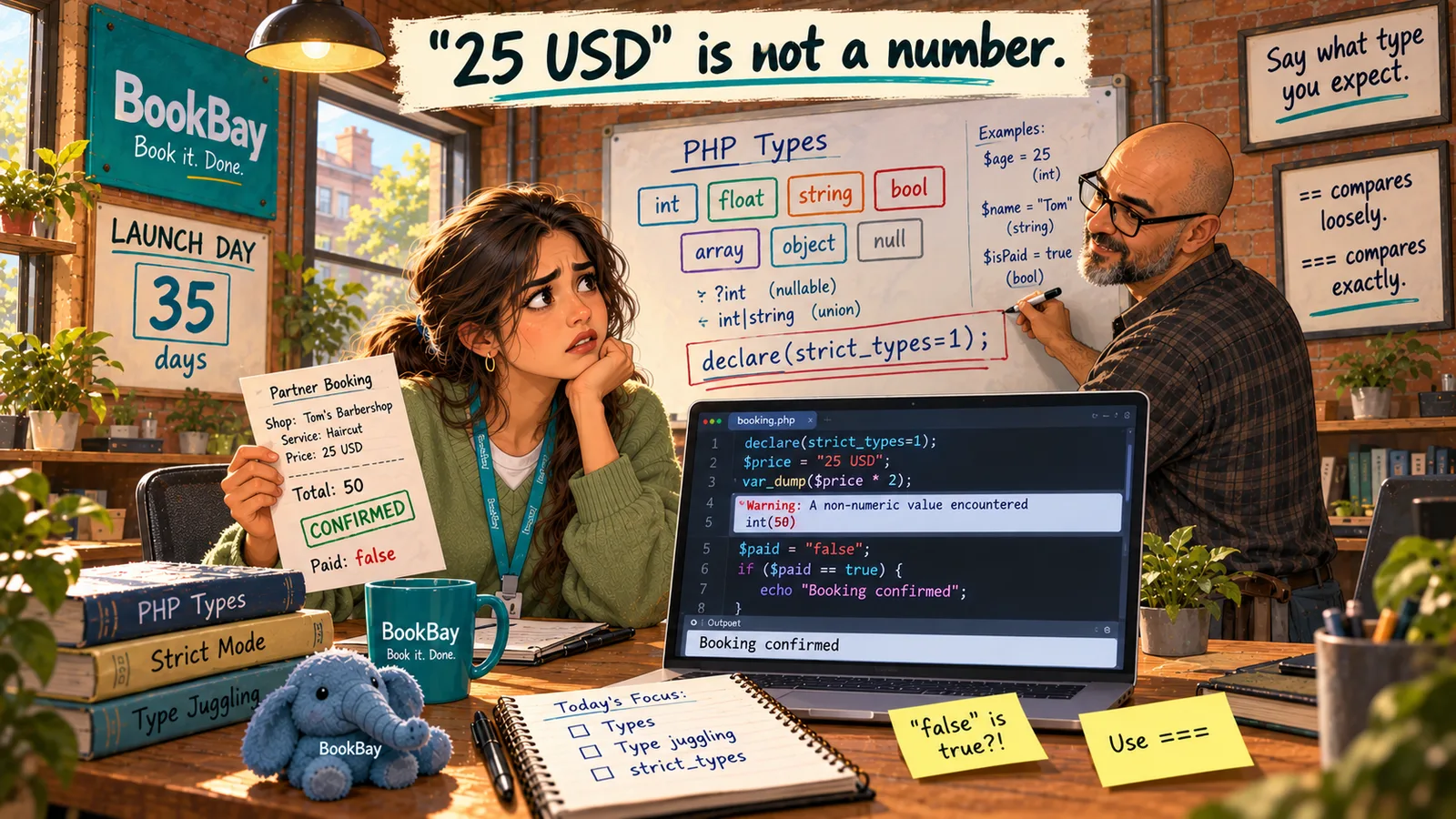
We'll learn exactly how PHP converts values from one type to another — automatically (type juggling) and on purpose (casting) — which strings count as numbers, what each value becomes as a bool, and why "false" == true gave away a free booking.
The Problem in Real Life
Back to the bug that started this Act. Mia writes the partner's booking out by hand: price "25 USD", paid "false". Then two lines of her own code: $price * 2 and if ($paid == true).
"PHP did two conversions here without asking," says Marcus. "It turned "25 USD" into a number, and "false" into a bool. Both conversions follow rules. Once you know the rules, you'll never be surprised by them again — and you'll know when to convert values yourself."
How can the text "false" be true?
Mia
Converting by Accident vs. Converting on Purpose
Silent conversions
Calculations, if checks and == comparisons all convert values without asking.
Surprising rules
"false" is true, "0" is false, and "25 USD" is 25 — if you don't know why.
Converting on purpose
Casts like (int) convert exactly when you decide — but they never complain.
Type Juggling, Coercion and Casting
Three words for converting: PHP converts values between types in three situations, and each has a name:
- Type juggling: PHP converts automatically because of what you're doing — maths needs numbers, joining text needs strings,
ifneeds a bool,==needs two comparable values. Also called implicit conversion. - Coercion: PHP converts a value passed to a typed function parameter, in the default (non-strict) mode — Act 02, chapter 6.
- Casting: you convert a value on purpose, by writing the target type in brackets:
(int) $price. Also called explicit conversion.
Juggling in maths — numeric strings: for +, -, * and /, PHP needs numbers. Strings are converted by these rules. A numeric string — one that's entirely a number, like "25", "12.5", "1e3" or " 25" (spaces around are allowed) — is converted cleanly. A leading-numeric string, which starts with a number and then has other text, like "25 USD", is converted using just the number at the start — with a warning. A string with no number at the start, like "abc", can't be used at all: PHP throws a TypeError. That's Mia's first bug: "25 USD" * 2 gave 50 and a warning that nobody read.
<?phpvar_dump("25" * 2); // int(50): numeric, cleanvar_dump("12.5" + 1); // float(13.5): numeric, cleanvar_dump("25 USD" * 2); // int(50) — with a warningvar_dump("abc" * 2); // TypeError: Unsupported operand types: string * int
int(50)float(13.5)Warning: A non-numeric value encountered in main.php on line 5int(50)Fatal error: Uncaught TypeError: Unsupported operand types: string * int in main.php:6
Juggling to string: echo and the . operator need text, so other types are converted to strings: 25 becomes "25", 12.5 becomes "12.5", true becomes "1", and false and null become empty text (Act 02, chapter 5). That's why "10" . 5 is "105" while "10" + 5 is 15 — the operator decides the conversion.
<?phpvar_dump("10" + 5); // int(15): + needs numbersvar_dump("10" . 5); // string(3) "105": . needs text
Juggling to bool: if (Act 06) needs a bool, so other types are converted. Only a few values become false — the same "empty-like" values as empty() in Act 03: 0, 0.0, "", "0", null and []. Everything else is true, including " ", "0.0", -1, [0] — and the text "false". PHP doesn't read the word; it only sees a non-empty string. That's Mia's second bug.
<?php$paid = "false"; // from the partner, as textif ($paid == true) {echo "Booking confirmed\n"; // printed!}var_dump((bool) "false"); // bool(true)var_dump((bool) "0"); // bool(false)var_dump((bool) " "); // bool(true)var_dump((bool) [0]); // bool(true): a list with one item
Juggling in == comparisons: == ("loosely equal") converts values before comparing, when their types differ. Some results are reasonable — "25" == 25 is true. Others are traps: "false" == true is true (the string is converted to a bool), null == false is true, and "10" == "1e1" is true (both are numeric strings, so they're compared as numbers). PHP 8 fixed the worst one: "abc" == 0 used to be true and is now false. The cure is the strict comparison ===, which never converts: the values must have the same type and the same value. Act 05 covers both in depth; from today, prefer ===. The table below collects the surprises.
| Comparison | Result | Why |
|---|---|---|
| "25" == 25 | true | The numeric string is compared as a number |
| "false" == true | true | Any non-empty string except "0" is true |
| null == false | true | null converts to false |
| "10" == "1e1" | true | Both are numeric strings: 10 and 10 |
| "abc" == 0 | false | PHP 8: compared as strings (was true before PHP 8) |
| "25 USD" == 25 | false | Not fully numeric, so compared as strings |
| "25" === 25 | false | === never converts: string vs. int |
<?php$paid = "false";var_dump($paid == true); // bool(true): converted, wrongvar_dump($paid === true); // bool(false): a string is never the bool truevar_dump($paid === "true"); // bool(false): the honest check for this data
Casting — converting on purpose: to convert yourself, put the type in brackets before the value: (int), (float), (string), (bool) or (array). The functions intval(), floatval(), strval() and boolval() do the same. Casting follows the same rules as juggling, with one big difference: casting never warns and never fails. (int) "25 USD" is silently 25, (int) "USD 25" is silently 0, and (int) 12.9 is 12 — the decimals are cut off, not rounded. The table below shows common results.
| Cast | Result | Note |
|---|---|---|
| (int) "25" | 25 | Clean |
| (int) "25 USD" | 25 | No warning — the rest is ignored |
| (int) "USD 25" | 0 | No warning — no number at the start |
| (int) 12.9 | 12 | Cut off, not rounded |
| (float) "12.50" | 12.5 | Clean |
| (string) false | "" | Empty text |
| (bool) "0" | false | One of the few false strings |
| (bool) "false" | true | A non-empty string |
| (array) "Tom" | ["Tom"] | Wrapped in a one-item list |
<?phpvar_dump((int) "25 USD"); // int(25)var_dump((int) "USD 25"); // int(0): a silent zerovar_dump((int) 12.9); // int(12): cut offvar_dump(intval("42")); // int(42)var_dump((string) 25); // string(2) "25"
No warnings at all — which is exactly why casting is not a way to check data.
When to cast, and when not to: casting is the right tool when you already know the value is valid — for example, after checking it (chapter 8). It's the wrong tool for checking: (int) "USD 25" doesn't tell you anything went wrong, it just gives you 0, and a price of 0 is how a free haircut happens. So the order is always: check first, then convert, then pass the value to typed functions. For the partner booking, that means: check that the price is a whole number, convert it, and compare paid with === "true" — never with == true.
Key Takeaway
PHP converts types automatically (juggling) in maths, string joins, if conditions and == comparisons; for typed parameters in non-strict mode (coercion); and when you cast with (int), (string) and so on. Leading-numeric strings like "25 USD" juggle with a warning, non-numeric ones throw. Only 0, 0.0, "", "0", null and [] are false — "false" is true. Casts never warn, so check values first, then cast, and compare with ===.
Why This Matters
Type juggling is the source of some of PHP's most famous bugs — and most of them come from data that arrives as text, which at BookBay is almost all of it. Knowing the rules turns "PHP is weird" into "of course: a non-empty string is true".
It also sets Mia's habit for the rest of the course: compare with ===, check outside data before using it, cast only values you've already checked, and let typed functions reject everything else loudly.
Mia rewrites the paid check as $paid === "true". But the price still worries her. "I can't cast "25 USD", because casting never complains. So how do I ask PHP whether a value is a proper number before I convert it?" That's the last chapter of this Act.