

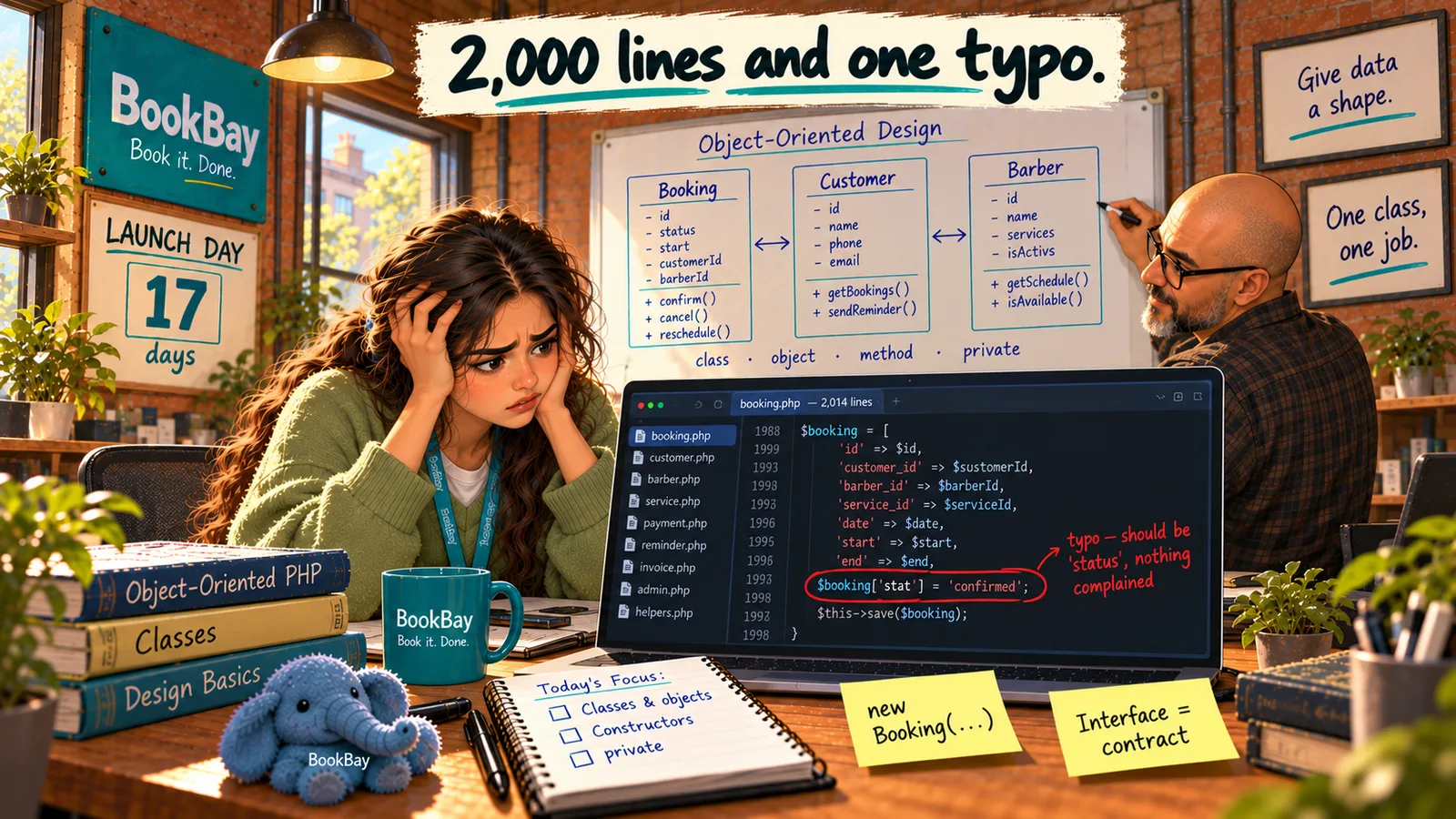
In this chapter
We'll learn the ideas that hold OOP together — encapsulation, abstraction and polymorphism — by replacing an instanceof chain with objects that answer for themselves, and the forms of polymorphism other languages have that PHP doesn't: operator overloading, generics and multiple dispatch.
The Problem in Real Life
The price code has grown a long chain: if ($booking instanceof GroupBooking) { ... } elseif ($booking instanceof StaffBooking) { ... } else { ... }. Gift bookings, added last week, aren't in it — so they fall into the else and are charged the full price.
"Every time the code asks an object what it is, so that it can decide what to do with it," says Marcus, "it's doing the object's job for it."
Every booking type has its own price rule. Why does the price code have to know all of them?
Mia
Asking What It Is vs. Telling It What to Do
instanceof chains
Code that checks the class before acting must be updated for every new class — and quietly fails when it isn't.
Rules inside the object
Encapsulation keeps each booking's data and rules together, behind methods.
Same call, right answer
Polymorphism: price() on any booking gives that booking's price — the caller never asks which kind it is.
Encapsulation, Abstraction and Polymorphism
The ideas behind the syntax: chapters 1 to 9 were the tools. OOP is usually summed up in four principles — encapsulation, abstraction, inheritance (chapter 7) and polymorphism. This chapter covers the other three, and the parts of polymorphism PHP doesn't have:
- Encapsulation: an object guards its own data.
- Abstraction: code depends on what an object does, not how.
- Polymorphism: the same call does the right thing for each kind of object.
- Operator overloading, generics and multiple dispatch: what other languages have, and what PHP does instead.
Encapsulation: an object encapsulates its data: it keeps it private and offers methods that keep it valid (chapter 4). The rules about bookings live in Booking, so a booking can never be in an impossible state, like confirmed after being cancelled. A practical test is the "tell, don't ask" rule: instead of asking an object for its data and deciding outside (if ($booking->status() === "pending") { ... set status ... }), tell it what you want ($booking->confirm()) and let it decide.
<?phpdeclare(strict_types=1);class Booking{private string $status = "pending";public function confirm(): void // the rule lives here{if ($this->status === "cancelled") {throw new LogicException("Cancelled bookings can't be confirmed");}$this->status = "confirmed";}public function status(): string{return $this->status;}}$booking = new Booking();$booking->confirm(); // tell it — don't check its status outsideecho $booking->status(), "\n"; // confirmed
Abstraction: abstraction means showing only what matters and hiding the rest. The Notifier interface (chapter 8) is an abstraction: confirmation code knows that a notifier can send(), and nothing about SMS gateways, email servers or WhatsApp APIs. Every public method is a small abstraction too: $booking->price() hides whether there's a discount, a surcharge or a group size behind it. Good abstractions make code shorter to read and safe to change, because the details can change behind them.
Abstraction vs. encapsulation: these two are easy to mix up, and interviewers love to ask about them. Encapsulation is about protecting: hide the data and let only the object's own methods change it, so it stays valid (private properties, public methods). Abstraction is about simplifying: show only what a user of the object needs and hide how it works (interfaces, clear public methods). They work together — Booking::confirm() is abstraction (callers just say "confirm") built on encapsulation (the status is private and the rule is inside) — but they answer different questions, as the table below shows.
| Question | Encapsulation | Abstraction |
|---|---|---|
| Main idea | Protect the data | Hide the details |
| Answers | Who may change this, and how? | What does the user need to know? |
| PHP tools | private / protected, readonly, private(set), methods with rules | Interfaces, abstract classes, well-named public methods |
| BookBay example | status is private; only confirm() and cancel() change it | confirm(Notifier $n) works without knowing SMS from email |
| Without it | Any code can write status = "confirmd" | Every caller must know every channel's details |
Polymorphism: polymorphism ("many forms") means one call works on objects of different classes, and each object answers in its own way. $booking->price() runs GroupBooking::price() for a group, GiftBooking::price() for a gift and Booking::price() for the rest — PHP picks the method from the object's class at runtime. That replaces Mia's instanceof chain: each class carries its own price rule, and the total is just array_sum(array_map(fn($b) => $b->price(), $bookings)). A new kind of booking brings its own price(), and the total code never changes. Polymorphism works through inheritance and through interfaces alike. And because PHP checks methods at runtime, it also works without any shared type at all — any object with a price() method can be asked — which is called duck typing ("if it walks like a duck…"). Typed interfaces are safer: PHP and your tools check them. The diagram below follows one call to price() through PHP's choice.
One call, the right method: how PHP picks price()
$booking->price()
the code doesn't know which kind of booking it has
PHP looks at the object's class
at runtime, when the line runs
GroupBooking → GroupBooking::price()
13500
GiftBooking → GiftBooking::price()
0
Booking → Booking::price()
2500
<?phpclass Booking {}class GroupBooking extends Booking {}class GiftBooking extends Booking {}function priceOf(Booking $b): int{if ($b instanceof GroupBooking) {return 13500;} elseif ($b instanceof Booking) {return 2500; // GiftBooking lands here: no discount}return 0;}echo priceOf(new GroupBooking()), " ", priceOf(new GiftBooking()), "\n"; // 13500 2500
<?phpdeclare(strict_types=1);class Booking{public function price(): int{return 2500;}}class GroupBooking extends Booking{public function price(): int{return 13500;}}class GiftBooking extends Booking{public function price(): int{return 0; // paid by the voucher}}$bookings = [new Booking(), new GroupBooking(), new GiftBooking()];$total = array_sum(array_map(fn(Booking $b) => $b->price(), $bookings));echo $total, "\n"; // 16000 — and a new booking type never touches this line
Compile-time vs. runtime polymorphism: textbooks split polymorphism into two kinds by when the method is chosen. Compile-time (or static) polymorphism means the compiler picks the method before the program runs, from the types of the arguments — that's method overloading (chapter 2) and operator overloading, as in Java, C# and C++. Runtime (or dynamic) polymorphism means the method is picked while the program runs, from the object's real class — overriding, as in the diagram above. The matching words are early binding (decided before running) and late binding (decided while running). PHP has only runtime polymorphism: it has no overloading, and even static:: (Act 12) is resolved at runtime. The table below sums it up.
| Compile-time (static) | Runtime (dynamic) | |
|---|---|---|
| When the method is chosen | Before the program runs (early binding) | While it runs (late binding) |
| Chosen by | The argument types | The object's actual class |
| Mechanism | Method and operator overloading | Overriding, interfaces |
| Languages | Java, C#, C++ | Java, C#, C++, PHP, Python |
| In PHP | Not supported | Supported: every method call |
Operator overloading — not in PHP: in C++, Python and C#, a class can define what operators like +, - or < mean for its objects, so $a + $b on two Money objects returns a new Money. That's operator overloading, a form of polymorphism for operators. PHP doesn't support it for your classes: $a + $b on two objects is a TypeError ("Unsupported operand types: Money + Money"). You write a method instead: $a->plus($b). (A few of PHP's own classes, like GMP for huge numbers, overload operators internally, and < and == compare objects property by property — chapter 13 — but your classes can't define their own operators.)
# Python — a class decides what + means for its objectsclass Money:def __init__(self, pence):self.pence = pencedef __add__(self, other): # called for a + breturn Money(self.pence + other.pence)total = Money(2500) + Money(250)print(total.pence) # 2750
<?phpdeclare(strict_types=1);final readonly class Money{public function __construct(public int $pence) {}public function plus(Money $other): Money{return new Money($this->pence + $other->pence);}}$a = new Money(2500);$b = new Money(250);try {$sum = $a + $b;} catch (TypeError $e) {echo $e->getMessage(), "\n"; // Unsupported operand types: Money + Money}echo $a->plus($b)->pence, "\n"; // 2750
Generics — not in PHP: in Java, C#, TypeScript and many others, a class or function can take a type parameter: List<Booking> is a list that only holds bookings, checked by the compiler. That's generics, also called parametric polymorphism. PHP doesn't support generics in the language; an array can't say "array of Booking". PHP developers write the type in a doc comment instead — /** @var list<Booking> */ or a class with @template T — and let PHPStan (Act 21) check it before the code runs. (Laravel's collections are documented exactly this way.)
// Java — the compiler knows this list holds only BookingsList<Booking> day = new ArrayList<>();day.add(new Booking());// day.add("Tom"); // compile error// PHP — no generics in the language; PHPStan reads the doc comment:// /** @var list<Booking> $day */// $day = [];// $day[] = "Tom"; // PHPStan: list<Booking> does not accept string
Multiple dispatch — not in PHP: PHP picks the method to run from one object: the one before the arrow. Languages with multiple dispatch, like Julia (and Common Lisp), pick it from the types of all the arguments, so collide(Asteroid, Ship) and collide(Ship, Ship) can be separate functions under one name. PHP doesn't support that; it's the same limit as method overloading (chapter 2). When the right behaviour depends on two objects, PHP code uses match on the types or a pattern called double dispatch (one object calls back the other). The table below collects every form of polymorphism and where PHP stands.
| Form | Example | PHP |
|---|---|---|
| Subtype (inheritance, interfaces) | $booking->price() on any Booking | Yes |
| Duck typing | Any object with a price() method | Yes, at runtime (no type check) |
| Method overloading | price() / price(int) (Java, C#) | No (chapter 2) |
| Operator overloading | $a + $b on Money (C++, Python, C#) | No: TypeError; use $a->plus($b) |
| Generics (parametric) | List<Booking> (Java, C#, TypeScript) | No: @template docblocks + PHPStan |
| Multiple dispatch | collide(Ship, Asteroid) (Julia) | No: match or double dispatch |
Key Takeaway
Encapsulation keeps data and rules together behind methods (tell, don't ask). Abstraction exposes what an object does and hides how — interfaces and public methods. Polymorphism lets one call, like $booking->price(), run the right method for each object's class, replacing instanceof chains; PHP also allows duck typing. PHP doesn't support operator overloading (use methods like plus()), generics (use @template docblocks + PHPStan) or multiple dispatch (use match or double dispatch).
Why This Matters
instanceof chains are how code ends up charging a gift voucher the full price: every new kind of object needs every chain updated. Polymorphism turns that around — the new class brings its own behaviour, and the code that uses it stays exactly as it was.
These principles are also the shared vocabulary of every developer conversation about design, in PHP or any other language. Knowing precisely which kinds of polymorphism PHP has — and which it fakes with methods and doc comments — keeps you from looking for operator overloading or generics that aren't there.
Each booking type now answers price() for itself, and gift bookings cost £0. Then a customer changes her phone number, and her reminders for next week still go to the old one. Each Booking stored its own copy of the phone number when it was created, instead of pointing at the customer. How objects should be connected to each other is the next chapter: composition, aggregation, association and dependency.