

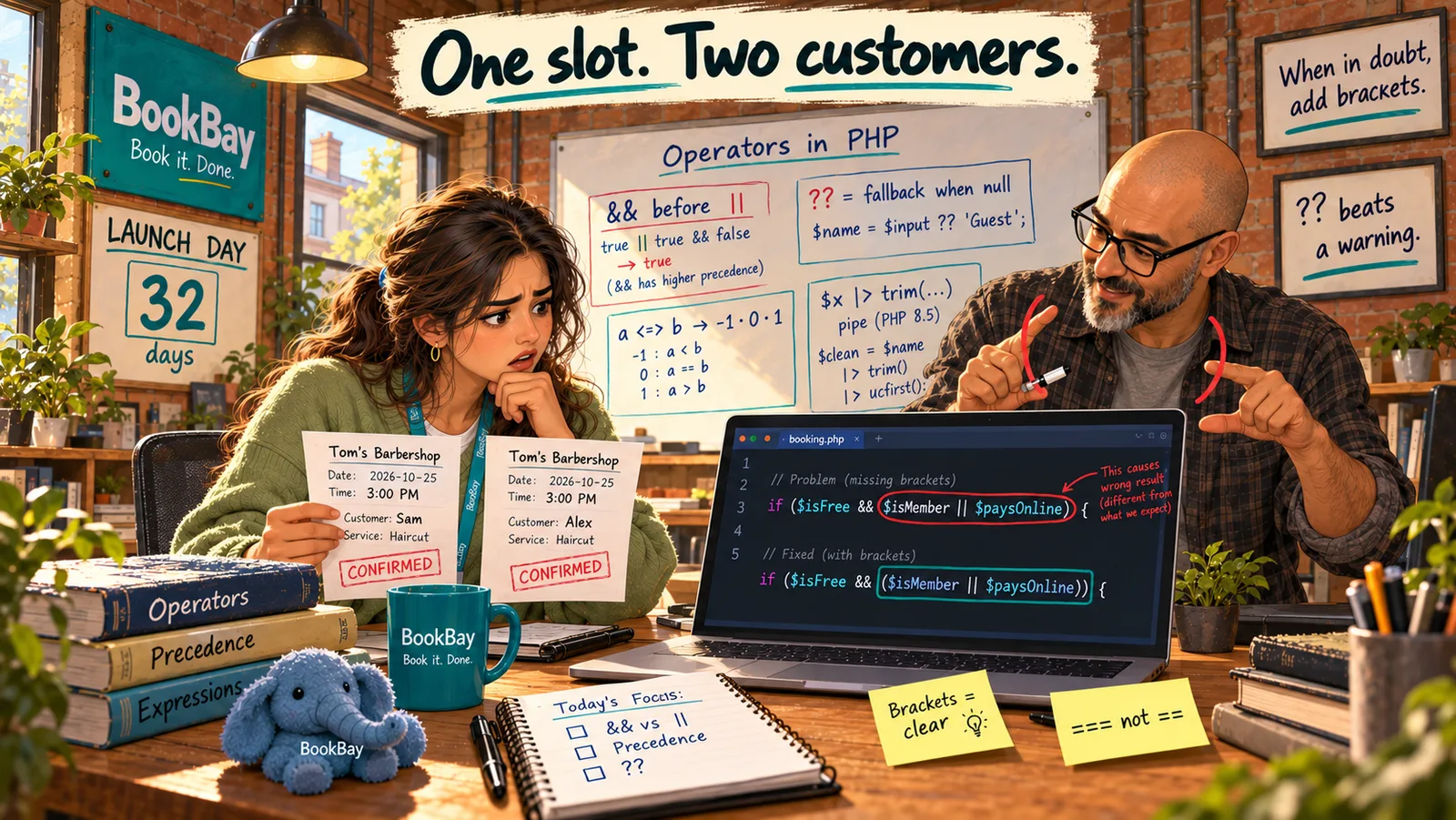
Playground Checkpoint
Rewrite the slot-availability check so it's correct and readable — five test cases tell you when it is.
The Challenge
Olivia's rule, word for word: "A slot can be booked if it's free, and the customer is a member or pays online, and the time is within opening hours — 9:00 to 18:00."
Open the starter in the PHP Playground with the button below. It contains canBook(), written in one long line with no brackets, and five test cases. Run it: two of the five answers are wrong. Rewrite the function so all five match, and so that Olivia could read it.
What You Need to Do
- Run the starter first and find the two cases where the result doesn't match the expected answer. Write down, for each, how PHP grouped the line (chapter 3 and chapter 7).
- Rewrite the body of
canBook()so all five cases print the expected answer. - Split the rule into named bool variables — for example
$canPayand$isDuringOpeningHours— and combine them in one short final line. - Use only
&&,||and!(noand/or), and strict comparisons where you compare values. - Use brackets wherever a reader might hesitate about the grouping.
- Keep the test lines exactly as they are. The final output must match the expected output, with no warnings.
Stuck? A Few Hints
- && is worked out before ||, so the starter's line groups as (free and member) or (online and hours). That's not Olivia's rule (chapter 3).
- The opening-hours check needs two comparisons: from 9 (included) up to 18 (not included). Comparisons can't be chained — join them with && (chapter 2).
- The payment part is the only "or" in the rule. Give it its own variable, and the rest becomes three ands.
- Case 2 is Friday's double booking: a taken slot, an online payer.
Ready to Build It?
Opens the Playground, right in your browser — nothing to install.
A correct run prints five lines where every answer matches its expectation: Case 1: yes (expected yes) · Case 2: no (expected no) · Case 3: no (expected no) · Case 4: no (expected no) · Case 5: no (expected no) — and no warnings.
Before You Move On
If all five cases match, the line that caused Friday's double booking is now a rule anyone can read: three named facts joined by &&. Along the way you've met every PHP operator — arithmetic, comparison, logical, string, array, bitwise, the null and ternary family, and PHP 8.5's pipe — and the precedence rules that decide how they combine. Next: making decisions and repeating work with control flow — if, match and loops.