

In this chapter
We'll see why a fraud ring stayed invisible to a relational, one-account-at-a-time review, and meet the graph database's core shift: relationships stored and queried as real data, not reconstructed later with a join.
The Problem in Real Life
GreenMart's referral program is working — new seller accounts, each one referred by an existing one, each one passing every individual check. Real name, real email, real first order. Sarah runs the fraud-review query she always runs, the one that checks each account on its own. Every single one comes back clean.
Mike isn't convinced. Something about how fast this particular batch of accounts grew feels wrong, even though nothing about any one of them is.
Every account looks fine by itself. What if the problem was never in any one of them?
Mike
Checking Each Account vs. Checking How They're Connected
Clean individually, suspicious together
Every account in the ring passed its own review — the pattern only exists in how they're connected, not in any single one.
Nodes and relationships, both first-class
A graph database stores connections — referred-by, shares-device — with the same weight as the things they connect.
Stored, not reconstructed
A relational JOIN rebuilds a connection fresh every query. A graph stores that connection as data from the first write.
Not the right tool for everything
A graph earns its place specifically where the connections are the interesting part — not a universal replacement for every table.
Why the Relationship Itself Is Data
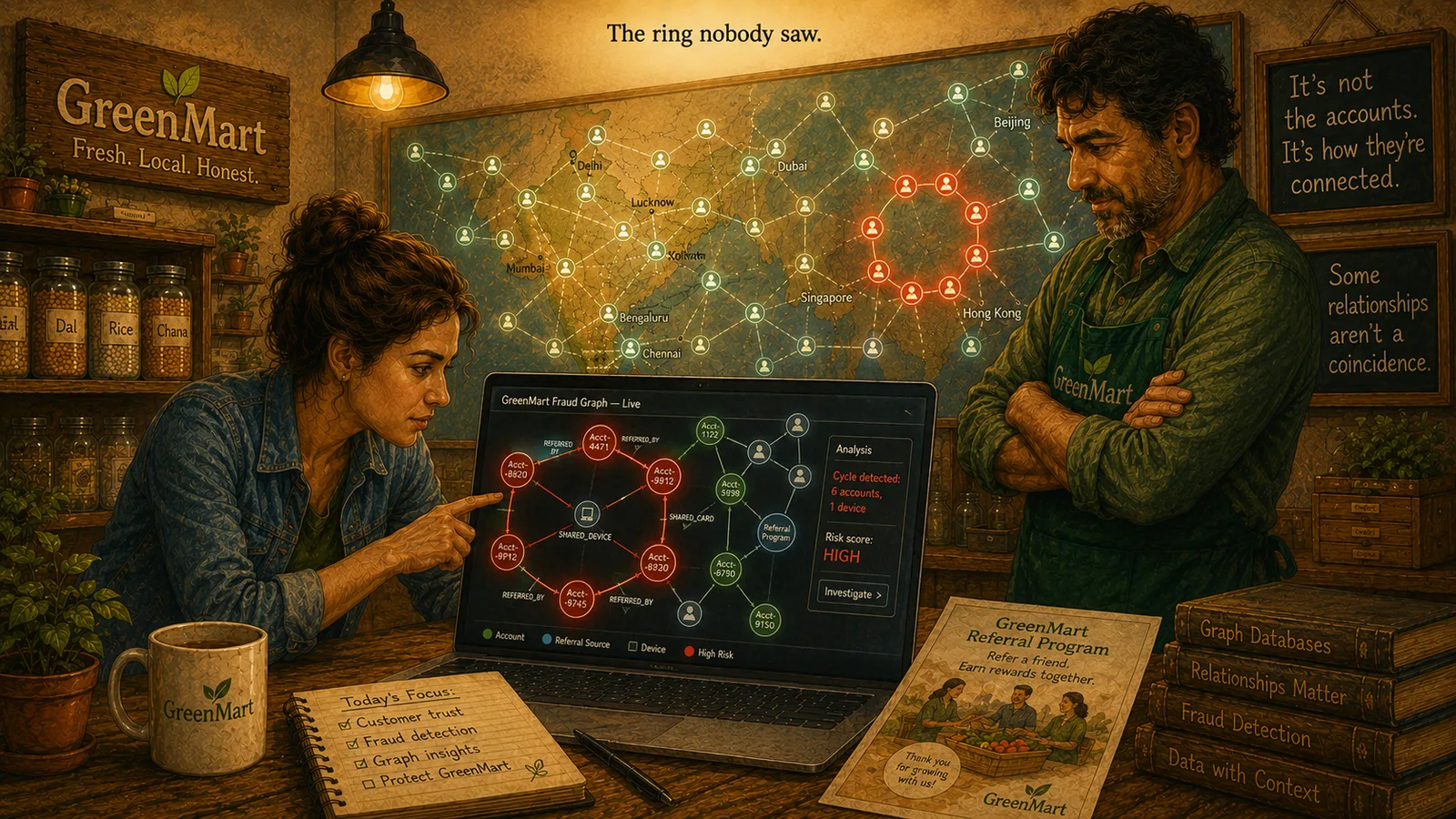
Sarah tries something different: instead of checking each account in isolation, she looks at how accounts relate to each other — who referred whom, which accounts share a device, which share a payment card. Drawn out, six accounts that each passed their individual review form a closed loop, connected by shared devices and shared cards, referring each other in a circle. A fraud ring, invisible in a table of individually-clean rows, obvious the moment the relationships themselves are looked at directly.
A graph database is built exactly for this shift. Where a relational table or a document stores each account as its own independent record, a graph stores accounts as nodes and the connections between them — referred-by, shares-device, shares-card — as first-class relationships, stored and queried with the same weight as the accounts themselves.
This isn't a new idea bolted onto an old database. It's a genuinely different starting question. A relational schema starts by asking "what are the things, and what facts do they have?" — and treats a connection between two things as something you reconstruct later, usually with a JOIN, computed fresh every time someone asks. A graph database starts by asking "what are the things, and how are they connected?" — and stores that connection as data from the very first write, not calculated after the fact.
This isn't the right tool for everything GreenMart stores — a product's price or a customer's shipping address doesn't become more useful by being modeled as a relationship. It earns its place specifically where the connections are the interesting part: a referral network, a fraud ring, "customers who bought this also bought that." The next few chapters build exactly that, starting with what a graph actually looks like once it's more than a metaphor.
Key Takeaway
In a graph database, the relationship isn't something you calculate later — the relationship itself is data, stored and queried directly, which is exactly what makes a six-account fraud ring visible the moment someone finally asks the right kind of question.
Why This Matters
Every remaining chapter in this Act assumes this one shift in what counts as data. The property graph model, traversals, fraud detection, and recommendations ahead are all really the same idea — relationships as first-class data — applied to a progressively more concrete problem.
GreenMart now has a name for what Sarah actually found: a fraud ring, visible only through its relationships, not through any single account. What a graph actually looks like once it's real data, not just a hand-drawn diagram, is exactly where the next chapter goes.