

In this chapter
We'll meet MongoDB's document model for real — collections, documents, fields, nested structure, and why schema flexibility doesn't mean "no rules ever."
The Problem in Real Life
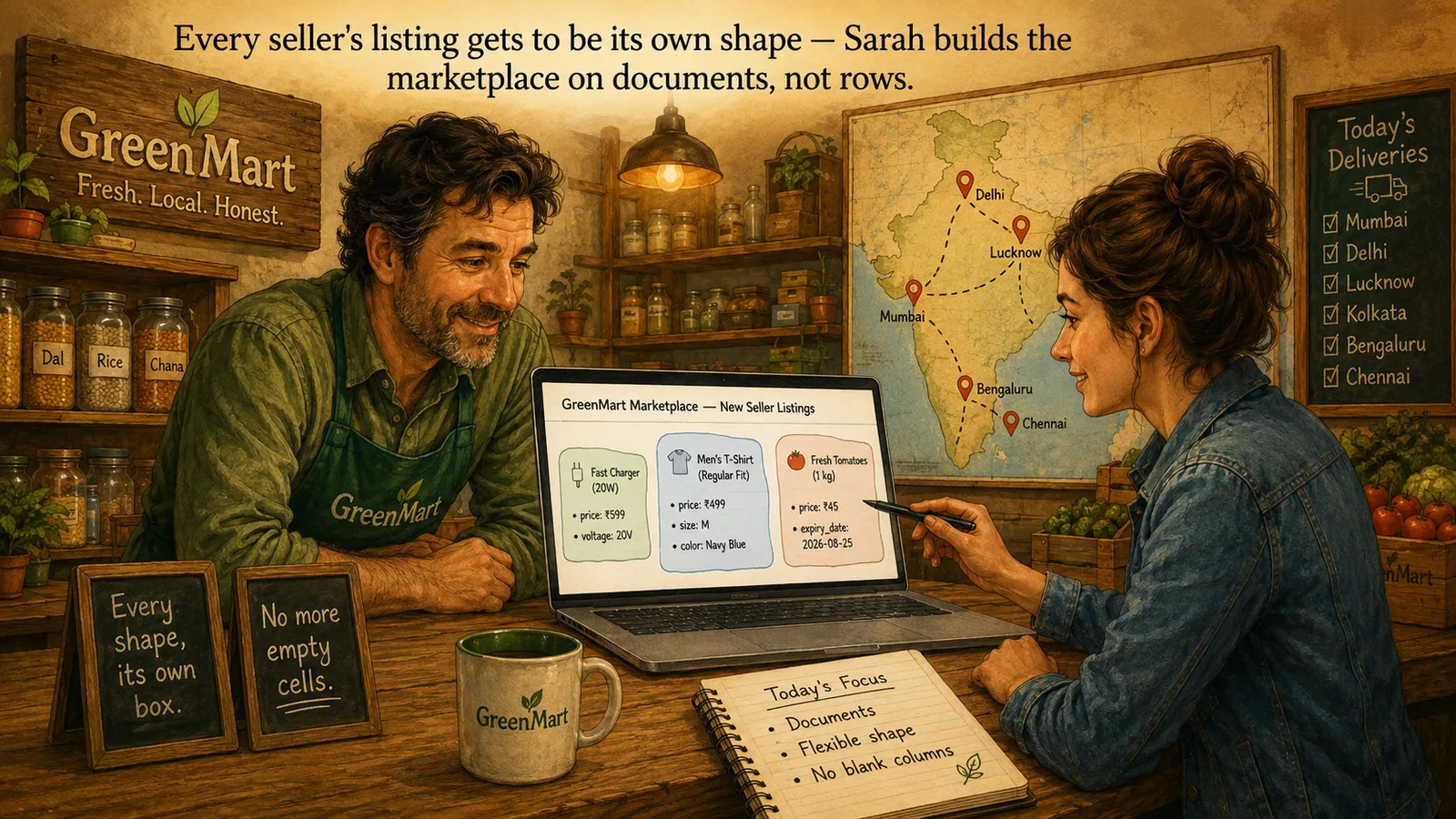
Sarah opens a blank project. No CREATE TABLE, no column list to argue over first. Just one collection — listings — and a decision from the checkpoint she's carrying straight into this Act: each listing gets to be its own shape.
She types the first real record straight in. Not a row. A document.
Wait — I don't have to tell it the columns first?
Sarah
One Table vs. One Document Per Listing
A document, not a row
A self-contained record that can nest its own fields, arrays, and structure — the direct fix for Act 1's sparse-table problem.
A collection, not a rigid table
Documents of a similar kind live together — but nothing forces them all to share the same fields.
Nested documents and arrays
A field's value can be a whole nested document, or a list — neither fits cleanly into one flat relational row.
Flexible by default, validated by choice
Schema validation still exists — optional rules a collection can enforce once GreenMart is confident about a shape.
The Document Model
GreenMart's new database is MongoDB — the first real, specific product this course actually names, after a whole Act spent on the concept it belongs to. It's a document database: instead of rows inside a fixed-column table, data lives as documents — self-contained records that look a lot like the JSON objects Sarah already knows from building the storefront's own frontend.
A collection is where documents of a similar kind live — listings, in this case — but "similar kind" is a much looser promise than a relational table makes. Nothing forces every document in listings to share the same fields. Each one just needs to make sense on its own.
Every field here belongs — nothing borrowed from a shared column list, nothing left empty for a size or an expiry date this product never had.
db.listings.insertOne({_id: "lst-fast-charger-20w",name: "Fast Charger (20W)",price: 8.99,category: "electronics",voltage: "20V",tags: ["electronics", "charger", "fast-charging"]})
Worth answering directly, since the name doesn't explain itself: why "document"? Look back at the listing above — every single value in it carries its own field name, written right there next to it: price: 8.99, voltage: "20V". A relational row doesn't do that. A row is just a sequence of bare values — "Fast Charger", 8.99, "20V" — and what each position actually means lives somewhere else entirely, in the table's own column definitions, not on the row itself. The listing above needs nothing outside itself to be understood; it labels its own data. That JSON object, exactly as written — self-labeled, self-contained, nothing external required to make sense of it — is the document. Not a row converted into JSON. Not a wrapper around the real data. The object itself, in full, is the document.
Under the hood, MongoDB doesn't store plain text JSON — it stores BSON (Binary JSON), a binary-encoded format that covers everything JSON can express, plus a few types JSON itself doesn't have (real dates, binary data) and faster for the database to read and traverse than parsing text every time. Sarah never writes BSON by hand — she writes JSON-shaped documents, and MongoDB handles the binary encoding underneath.
A document's individual key-value pairs are its fields — price, voltage, size — the same idea as a column, except a field only exists on the documents that actually use it. A field's value can also be another whole document nested inside it (a nested document — e.g. a dimensions field holding its own { length, width, height }), or a list of values (an array — e.g. tags: ["electronics", "charger"]). Neither of those has a clean equivalent in a single relational row.
This is schema flexibility in practice — no upfront column list, and every document can carry only what it actually needs. It doesn't mean "anything goes forever, no rules ever": MongoDB also supports schema validation — optional rules a collection can enforce (a field must exist, must be a certain type, must match a pattern) applied when GreenMart is confident enough about a shape to actually require it. Flexible-by-default and validated-when-you-choose-to are both true at once; one doesn't cancel out the other.
Key Takeaway
A document isn't a row with looser rules. It's a genuinely different unit — a self-contained record that can nest its own structure, in a collection that never forces every document through one shared column list.
Why This Matters
Every remaining chapter in this Act builds directly on this one shape. Deciding what belongs inside one document versus somewhere else (next chapter), querying and updating documents, running aggregations, indexing them, replicating and sharding them — all of it assumes this exact mental model first: a document, not a row, is the unit everything else in MongoDB is built around.
Sarah has her first real listing stored — shaped exactly like the product it describes, nothing forced, nothing empty. The very next decision is less obvious than it looks: not every piece of related data belongs inside that same document. That's exactly where the next chapter starts.