

In this chapter
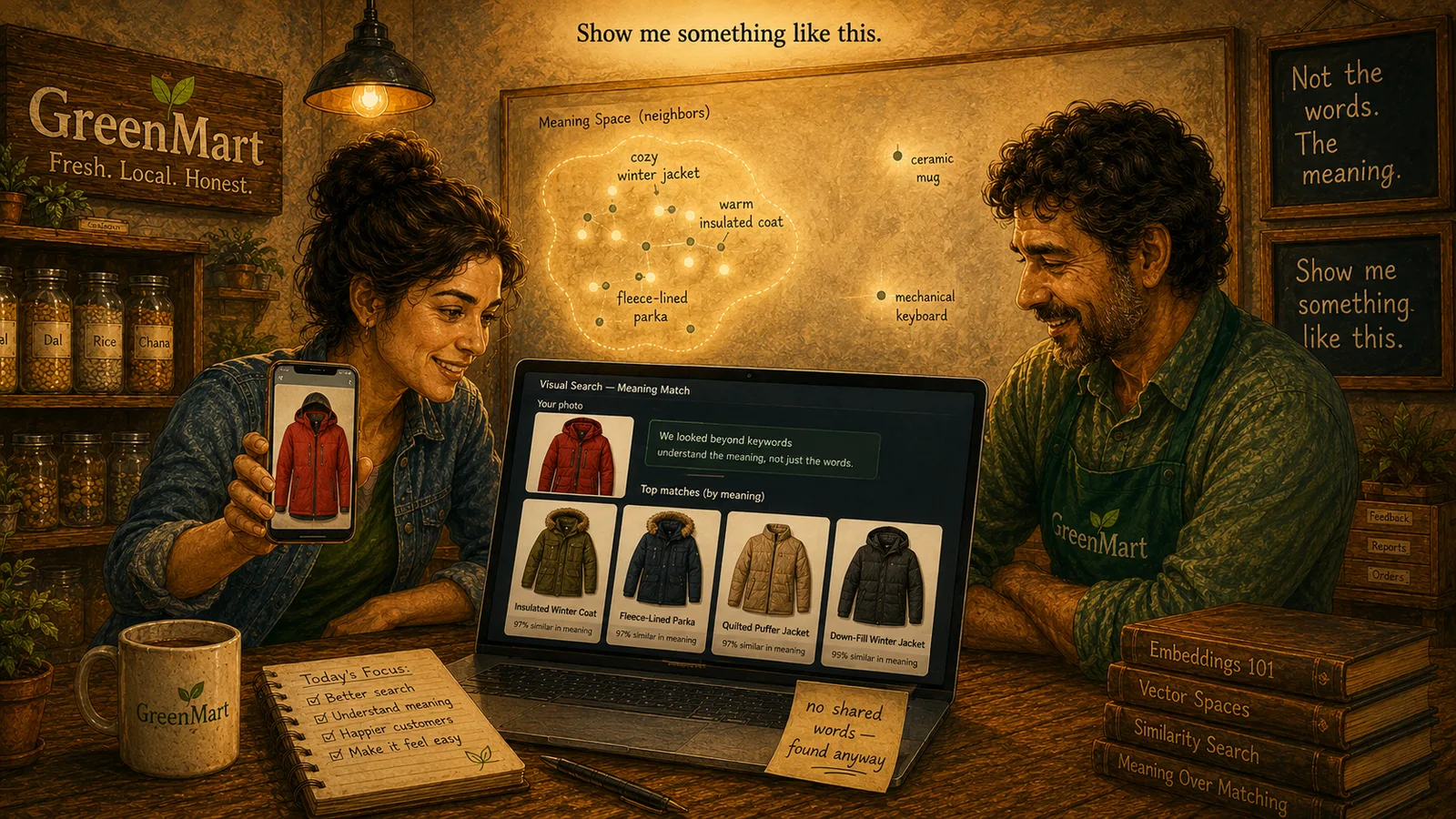
We'll meet vectors and dimensions, and see real, verified similarity scores from this course's actual embedding model — a true paraphrase scoring 0.55 with zero shared words, an unrelated pair scoring near zero, and GreenMart's own "cozy jacket" query scoring 0.68 against "Insulated Winter Coat."
The Problem in Real Life
Sarah types "cozy jacket for cold weather" into the search bar built back in Act 7. It comes back empty. GreenMart's own "Insulated Winter Coat" is exactly the right product — but it shares not one single word with the query. "Cozy" isn't "insulated." "Jacket" isn't "coat."
Fuzzy matching, from Act 7, tolerates a typo — a few wrong letters in an otherwise-similar word. It has nothing for two totally different words that happen to mean almost the same thing.
Every word is spelled correctly. None of them match. The problem isn't spelling anymore.
Sarah
Close in Spelling vs. Close in Meaning
A vector represents meaning, not spelling
Hundreds of numbers per piece of text — each one a learned dimension of meaning, not a human-labeled category.
Close vectors mean close meaning
Verified: zero shared words, 0.55 similarity for a true paraphrase; near-zero for genuinely unrelated text.
"Cozy jacket" really does find "Insulated Coat"
Real, verified: 0.6770 similarity, zero shared vocabulary — the exact problem Act 7's fuzzy matching couldn't solve.
A genuinely different question than Act 7's
Full-text search matches words, however tolerantly. A vector system matches at the level meaning actually lives at.
What a Vector Actually Is
A vector, for this purpose, is a long list of numbers — hundreds of them — that represents a piece of text's actual meaning, not its exact wording. Each number is one dimension, one measured aspect of that meaning (not a human-readable one, like "warmth" or "formality" — a real embedding model learns hundreds of dimensions on its own, in a way no person hand-labels or fully interprets, but the numbers work).
The real, useful property is this: two pieces of text with semantically similar meaning end up as two vectors that are mathematically close together, even if they don't share a single word. Two pieces of text with unrelated meaning end up far apart, even if they happen to share a word.
Run through the exact real embedding model behind this course's own Vector Playground, these two sentences — sharing not one single word — score 0.5453 on a -1-to-1 similarity scale. For comparison, "a happy dog running in the park" against "quarterly financial report" scores -0.0267 — genuinely unrelated, essentially zero. These are real numbers from a real model, not illustrative estimates.
a happy dog running in the parka joyful puppy playing outside
Cosine similarity (the actual metric here) ranges from -1 (opposite meaning) to 1 (identical meaning); 0 means unrelated. 0.55 for a true paraphrase, -0.03 for two unrelated sentences — that gap is the entire point.
This is exactly GreenMart's "cozy jacket for cold weather" problem, solved the same way. Run through the same real model, that query and "Insulated Winter Coat" score 0.6770 — genuinely, verifiably close in meaning, despite zero shared vocabulary. "Waterproof Hiking Jacket" scores 0.6047, also a real, relevant match. "Mechanical Keyboard" scores 0.0739 — correctly, almost completely unrelated.
This is the shift Act 7 never made, on purpose — Act 7's own search engine was always going to be about matching words, however tolerantly. A vector database asks a genuinely different question, at the actual level meaning lives at, not spelling.
Key Takeaway
Traditional databases search for matching data; vector systems search for data that is mathematically close in meaning. "Cozy jacket" and "Insulated Winter Coat" share zero words and still score 0.68 out of a possible 1.0 — a real, verified number, not a metaphor for how similarity search is supposed to feel.
Why This Matters
Every remaining chapter in this Act depends on this one shift being real, not aspirational — how text actually becomes a vector, how "close" gets found fast at real scale, and how this combines with everything Act 7 already built, all assume a reader trusts these numbers because they've seen them verified here first.
GreenMart now has real, verified proof that meaning-based matching works, using the exact model this course's own Playground runs. How a sentence — or a photo's caption — actually becomes one of these number-lists in the first place is exactly where the next chapter goes.