

In this chapter
We'll see why cramming every kind of seller listing into one relational table breaks down — and what "NoSQL" actually means.
The Problem in Real Life
GreenMart's new "Sell on GreenMart" program launches this week — any outside seller can list their own products on the platform. Sarah builds the intake form the way she's always built things: one Products table, one row per listing, using the schema Sarah and Mike designed together back when GreenMart only sold its own stock.
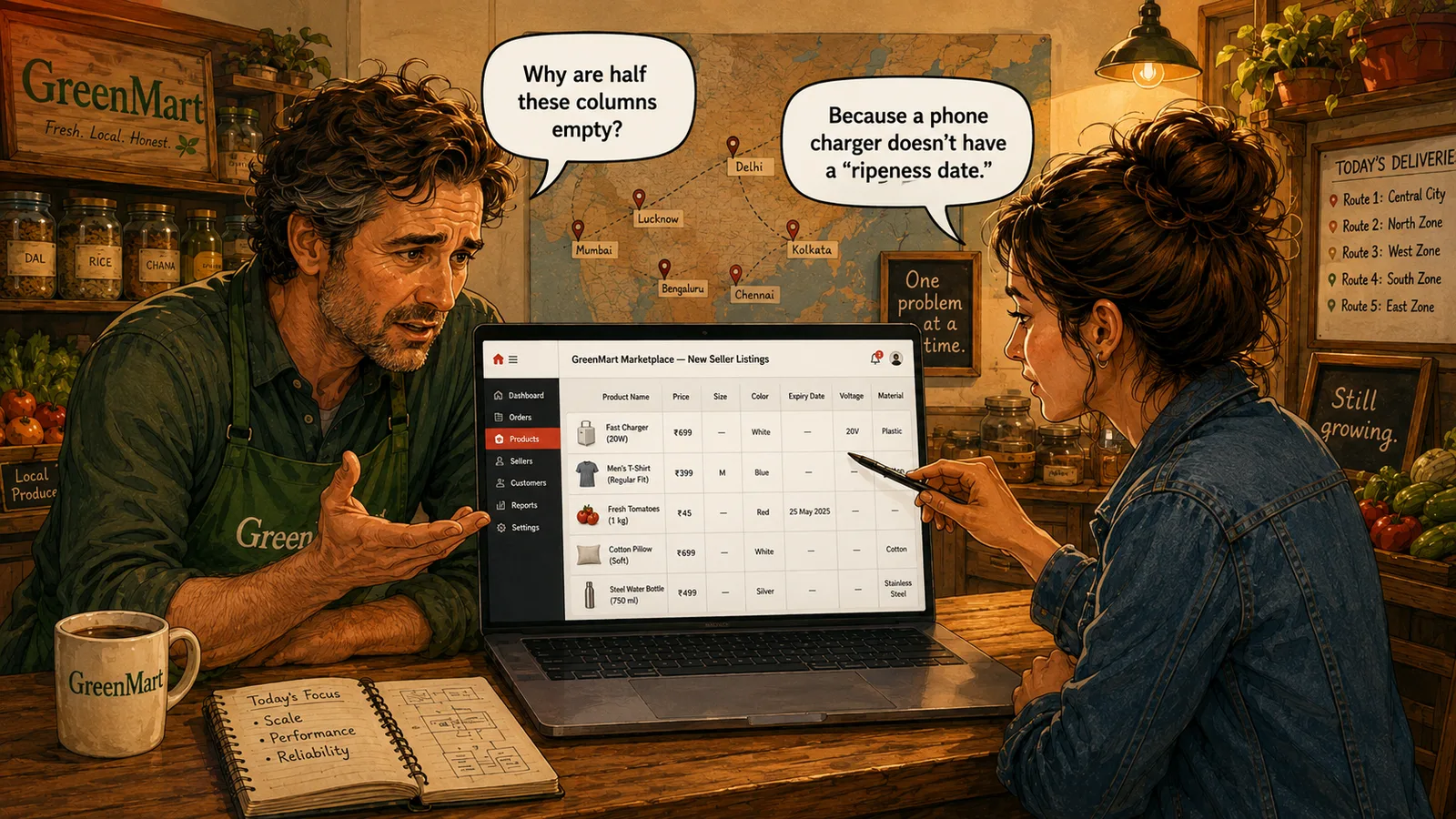
The first three sellers sign up on day one. An electronics seller lists a fast charger — it needs a voltage rating. A clothing seller lists a T-shirt — it needs a size and a color. A produce seller lists tomatoes — they need an expiry date. Mike opens the admin panel to check on the new listings, and stops.
| Product Name | Price | Size | Color | Expiry Date | Voltage |
|---|---|---|---|---|---|
| Fast Charger (20W) | $8.99 | — | White | — | 20V |
| Men's T-Shirt (Regular Fit) | $7.99 | M | Blue | — | — |
| Fresh Tomatoes (1 kg) | $1.99 | — | Red | 25 May 2025 | — |
One product table, one shared set of columns — and every single row is missing something. Not because a seller forgot to fill in a field. Because that field never applied to their kind of product in the first place.
Why are half these columns empty?
Mike
One Table vs. Every Seller's Shape
Sparse rows
Most cells in most rows sit empty — the attribute just never applied to that particular listing.
A new column for every category
Voltage, then ripeness, then fabric, then whatever the next seller needs — the table keeps growing sideways.
Shape decided in advance
A relational table's columns are fixed before the first row of real data ever exists — schema-on-write.
Not all data is the same shape
Electronics, clothing, and produce genuinely don't share one row shape — and one shared table doesn't change that.
What Is NoSQL, Really?
Sarah explains it the way Mike just watched it happen: the Products table has one column for every attribute any product might ever need — Size, Color, Expiry Date, Voltage — because that's the only way a relational table knows how to hold different kinds of things. Every row gets every column, whether it needs it or not.
This isn't a bug in how Sarah built the table. It's what a relational table always does. Back when GreenMart only sold its own stock, every row genuinely was the same shape — one customer, one sale, one product from GreenMart's own catalog. The table's fixed columns were never a problem, because nothing ever needed a column the table didn't already have.
A relational table decides its shape once, in the CREATE TABLE statement, before a single row of real data exists. Every row that ever gets inserted after that has to match — same columns, in the same order, whether that particular row actually uses all of them or not. This is called schema-on-write: the schema comes first, and every write has to fit it.
That's exactly what's breaking now. Electronics, clothing, and produce genuinely don't share one row shape. Forcing them into the same table doesn't make them the same — it just means most cells in most rows sit empty, not because the seller left something out, but because that attribute was never theirs to fill in.
This is the exact moment a database designer starts asking a different question — not "how do I add more columns to this table" but "does every one of these things actually belong in the same table at all?" That question has a name for the family of answers it leads to: NoSQL. Here's exactly what forcing everything into one table costs today:
- A new column for every seller category that shows up — Voltage, then Fabric, then Ripeness, then whatever the next seller needs
- Most cells in most rows sitting empty — not missing data, just data that was never going to apply to that row
- "Show me every listing" returning a table that's mostly blank space, one giant column list nobody's product uses all of
| Product Name | Price | Voltage |
|---|---|---|
| Fast Charger (20W) | $8.99 | 20V |
| Product Name | Price | Size | Color |
|---|---|---|---|
| Men's T-Shirt (Regular Fit) | $7.99 | M | Blue |
| Product Name | Price | Expiry Date |
|---|---|---|
| Fresh Tomatoes (1 kg) | $1.99 | 25 May 2025 |
Same three listings as the table above — but now each one only ever carries the columns it actually needs. No shared column list, so no empty cells forced onto anyone.
Split apart like this, the fix looks almost obvious. NoSQL stands for "Not Only SQL" — and that name is worth sitting with, because it's easy to mishear. It doesn't mean "no structure at all," and it doesn't mean throwing away everything GreenMart already relies on. It means: not only the relational model — tables, fixed columns, one shape for every row.
One more thing worth being precise about: NoSQL isn't itself a single database, the way SQLite or PostgreSQL is. It's a category name — a family of several genuinely different, real databases, each with its own actual way of storing data. Which one GreenMart actually needs, and how it really stores things, is exactly what the rest of this course walks through, one at a time.
A NoSQL database lets each record carry its own shape. The electronics seller's listing can have a Voltage field. The produce seller's listing can have an Expiry Date. Neither one needs a column it doesn't use, because there's no longer one shared column list every row is forced through.
This isn't just about shape, either. Relational databases were also built assuming one machine gets bigger over time to handle more load — vertical scaling: a faster CPU, more RAM, a bigger disk, same one server. Many NoSQL databases were built around the opposite assumption from day one — horizontal scaling: instead of one machine getting bigger, more machines get added, and the data spreads across all of them. GreenMart isn't at that scale yet, but the moment a marketplace opens to outside sellers, the shape problem shows up first — and it's exactly what's happening right now in this admin panel.
Key Takeaway
NoSQL isn't "no structure." It's structure that bends per record, instead of one shape forced onto every record.
Why This Matters
Every Act from here is really a deeper answer to the exact question this chapter just raised. MongoDB, coming up next, is the direct fix for this specific problem — every listing becomes its own document, shaped however that product actually needs. Redis, Cassandra, DynamoDB, and the rest each answer a different version of "what if the relational model's assumptions don't fit this workload" — speed, distributed writes, unpredictable scale. None of it makes sense without first seeing, concretely, what breaks when one rigid table meets data that was never going to be one shape.
Sarah doesn't have a fix yet — just a clearer name for the problem. The next question is obvious: if not one table for everything, then what? NoSQL isn't one alternative. It's a whole family of them, and the next chapter is where GreenMart meets all four.