

In this chapter
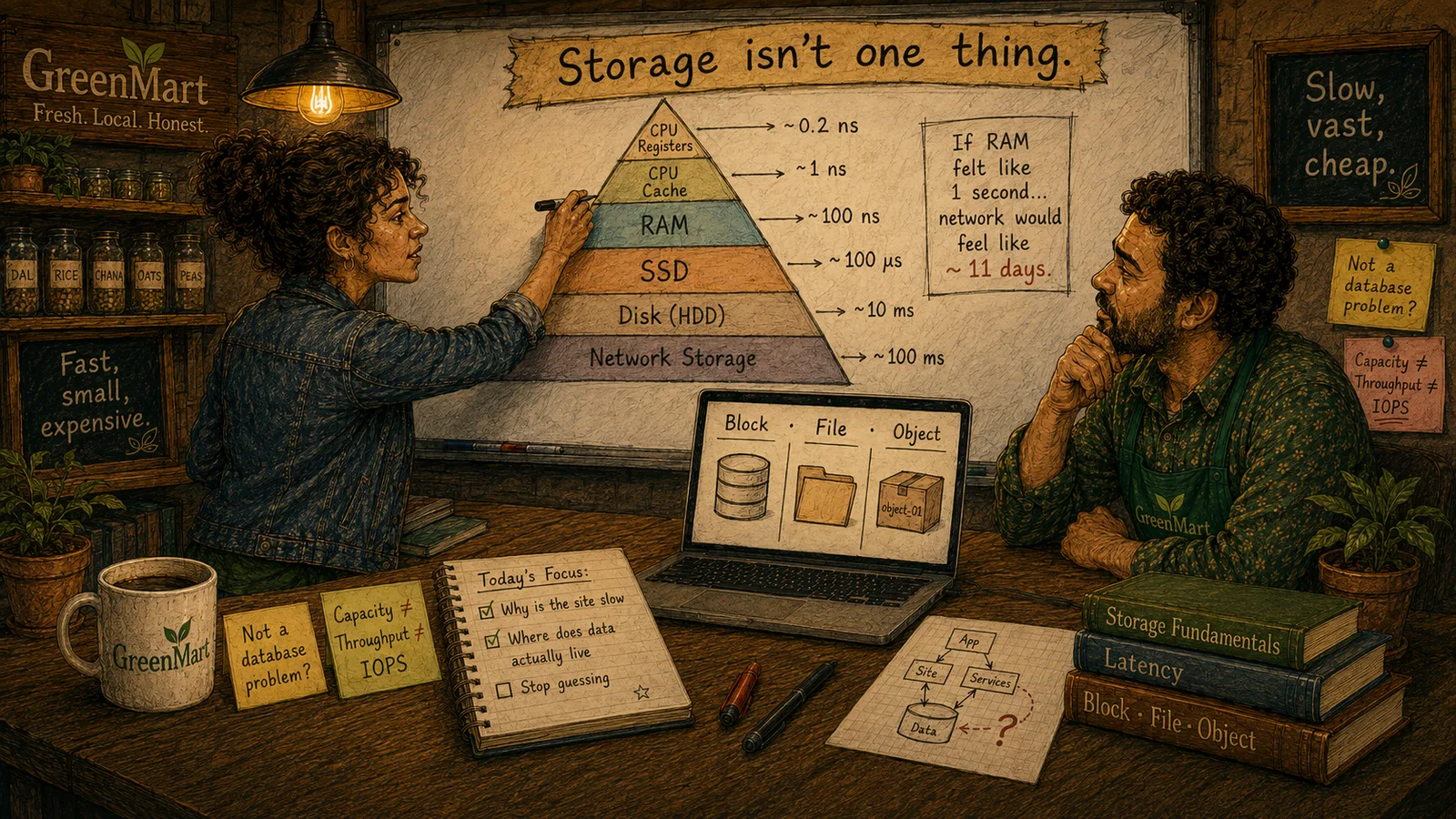
We'll meet the three real shapes storage can take — block (raw, numbered chunks), file (the familiar folder/file structure, built on top of blocks), and object (flat, key-addressed, built for huge numbers of large files) — as the real conceptual map the rest of this course builds on.
The Problem in Real Life
Sarah steps back from the whiteboard, where six labeled boxes sit in two rows — cookies, browser storage, and file system on top; cache, object storage, and block storage below. "Every single one of GreenMart's real problems lives in one of these," she says. "But they're not six random things. They're really just three real shapes, each showing up twice."
Mike looks at the board again, this time looking for the pattern instead of the individual boxes.
Six boxes on this whiteboard, but really only three real shapes underneath them.
Sarah
Three Real Shapes, Everything Else Is a Variation
Block is the rawest shape — no built-in structure
Fixed-size, numbered chunks with no idea of files or folders — that organization gets added by a layer built on top.
File is built directly on top of block
The familiar folder/file structure is a real, added layer over raw blocks, not a separate, unrelated shape.
Three Shapes of Storage
Underneath every specific storage technology this course will cover — browser APIs, caches, disks, cloud storage — there are only three fundamentally different shapes data can be organized into. Naming them now, honestly and briefly, gives the rest of this course a real map to place every later, more specific topic onto.
- Block storage is the rawest shape: fixed-size chunks ("blocks"), addressed by number, with no built-in idea of a "file" or "folder" at all — that structure gets added by something else layered on top. It's the shape closest to the hardware itself, and it's genuinely fast and flexible precisely because it doesn't impose any particular organization. Act 5 covers this shape in real depth.
- File storage organizes data the way most people already think about it: files, inside folders, inside more folders, each file with a name and a path. It's built on top of block storage — literally, the file system takes those raw numbered blocks and adds the folder/file structure everyone recognizes. Act 3 covers this shape in real depth, including exactly how that structure gets built on raw blocks underneath it.
- Object storage organizes data as whole, self-contained objects, each with a unique key, stored in a flat structure (no real folders, even when an interface pretends otherwise) — built specifically for storing huge numbers of large, mostly-unchanging files, like GreenMart's own product images and order receipts, at a scale a normal file system genuinely struggles with. Act 5 covers this shape in real depth too, right alongside block storage, since a full understanding of object storage leans on understanding blocks first.
None of GreenMart's real, everyday storage decisions is actually a decision about a specific product — it's a decision about which of these three real shapes actually fits the job. A product catalog's images are genuinely a better fit for object storage's shape than file storage's; a server's own configuration files are genuinely a better fit for file storage's shape than block storage's raw form. The specific technology comes second; the shape comes first.
Key Takeaway
Every storage technology this course will ever name is really just one of three shapes — block, file, or object — wearing a specific product's name. Learning the three shapes first means every later, more specific topic slots into a map that already makes sense, instead of arriving as one more unrelated fact to memorize.
Why This Matters
Without this map, every new storage technology GreenMart encounters looks like a brand-new thing to learn from scratch. With it, a new technology is instantly recognizable as "oh, that's object storage, we already understand the real shape" — a genuinely faster, more confident way to evaluate anything new.
GreenMart now has the real conceptual map this entire course is built on: block, file, and object, each a genuinely different shape for genuinely different jobs. The final chapter of this Act turns that map into an actual decision process — how GreenMart actually chooses where a specific piece of data should live.