

In this chapter
We'll name the one real habit underneath every storage decision this whole course has made — access-pattern-driven design, asking how data is actually read and written before choosing where it lives — and see it traced consistently across every layer, from browser storage to caching to storage engines.
The Problem in Real Life
Mike has a real, practical question. "Every time we've made one of these decisions — cache or not, which database, which storage class — it always started with the same real question. What's the actual pattern?"
Sarah smiles. "You've basically already learned the framework. I just want to name it, once, for everything — not just databases."
Every decision seems to start the same way. What's the real, common thread?
Mike
Choosing By Familiarity vs. Choosing By The Real, Actual Pattern
The real question, asked first, every time
Read/write ratio, consistency needs, growth shape — the same small question set decided every storage choice this course made.
Starting from the technology is backward
Every real incident this course covered traced back to the access pattern being asked after the storage choice, not before.
Choosing Storage by Access Pattern
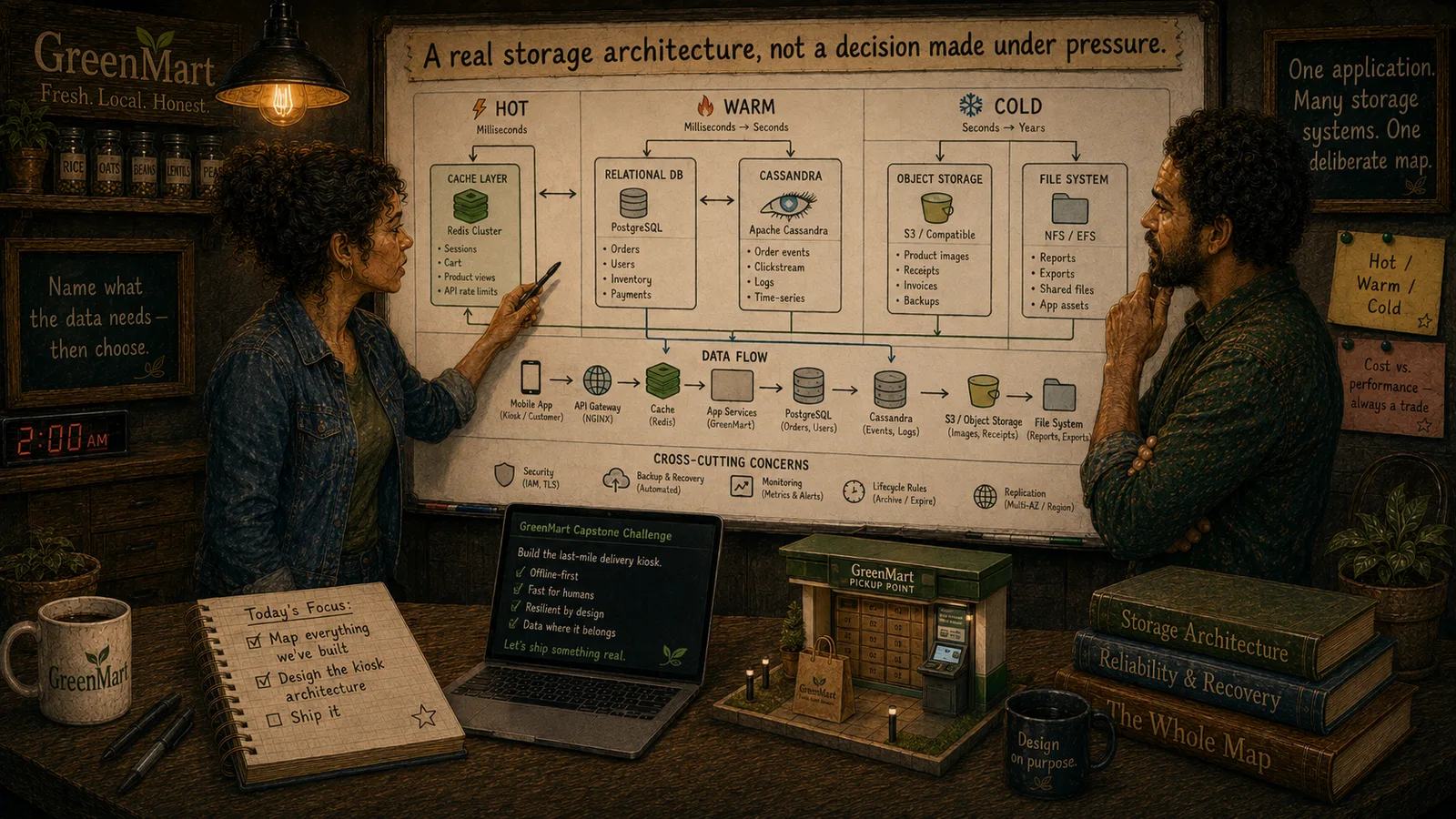
Access-pattern-driven design — a discipline first named for databases, in an earlier course — is really a genuinely universal real habit: name exactly how data will actually be read and written before choosing where it should live, applied here across every storage type this whole course has covered, not just databases.
- The same, real, small set of questions, asked everywhere. How often is this data read versus written? Is it read by one exact key, or searched/scanned? Does it need to survive a crash, a restart, a full outage? Does it need to be instantly consistent, or can it lag briefly? These real questions decided every choice made across this entire course — a cart's real shape decided browser storage (Act 2); an event log's real write pattern decided its storage engine (Act 6); a stock count's real staleness tolerance decided its caching strategy (Act 4).
- The real pattern, traced across every layer this course covered. Block storage suits data one server needs fast, low-level access to. Object storage suits data written once, read many times, growing without bound. A cache suits data read far more than it changes, tolerant of some staleness. A B-tree-based engine suits read-heavy or steady-write data; an LSM-tree-based one suits write-heavy, bursty data. None of these are separate, unrelated lessons — they're the exact same real question, asked at a different real layer each time.
- Why starting from the technology instead is a genuinely common, real mistake. Reaching for a familiar system first, then trying to make the data's actual shape fit it, is exactly backward — and it's precisely what caused this course's own real incidents: a stock count cached with a default TTL nobody chose deliberately, an event log written to a read-optimized database nobody had checked against its actual write pattern. Every one of this course's own incidents trace back to the access pattern being asked after the storage choice, not before.
- The real, complete checklist, unified. Read/write ratio and volume. Consistency and staleness tolerance. Growth shape — bounded or unbounded. Who else needs to read it, and how (a person, or only internal systems). This is the exact real question set every earlier chapter in this course asked, one storage type at a time — now named once, as one deliberate, repeatable real habit.
GreenMart now has the real, unifying thread underneath every storage decision this whole course has made — not eight separate lessons, but one real habit, applied consistently, at every layer, every time.
Key Takeaway
Access-pattern-driven design is one real, universal habit — name exactly how data will actually be read and written before choosing where it lives — and every storage decision this whole course has made, at every layer from browser storage to storage engines, was really just this same question, asked once more.
Why This Matters
Every future storage decision GreenMart makes — for a feature that doesn't exist yet, using a technology this course may not have even covered — can still start from this exact same real habit, which is the actual, lasting skill this whole course was built to leave GreenMart with.
GreenMart now has the one, real, unifying habit underneath every storage decision this course has made. The next chapter adds a second real lens to that habit: not just how data is accessed, but how its real value changes as it ages.