

In this chapter
We'll unpack what a real durability figure like '11 nines' actually claims for an object store specifically — a concrete, statistical outcome of keeping multiple real, physically-separated copies (multi-AZ) — distinct from availability, and deliberately without re-deriving the general distributed-systems replication theory this course already covers elsewhere.
The Problem in Real Life
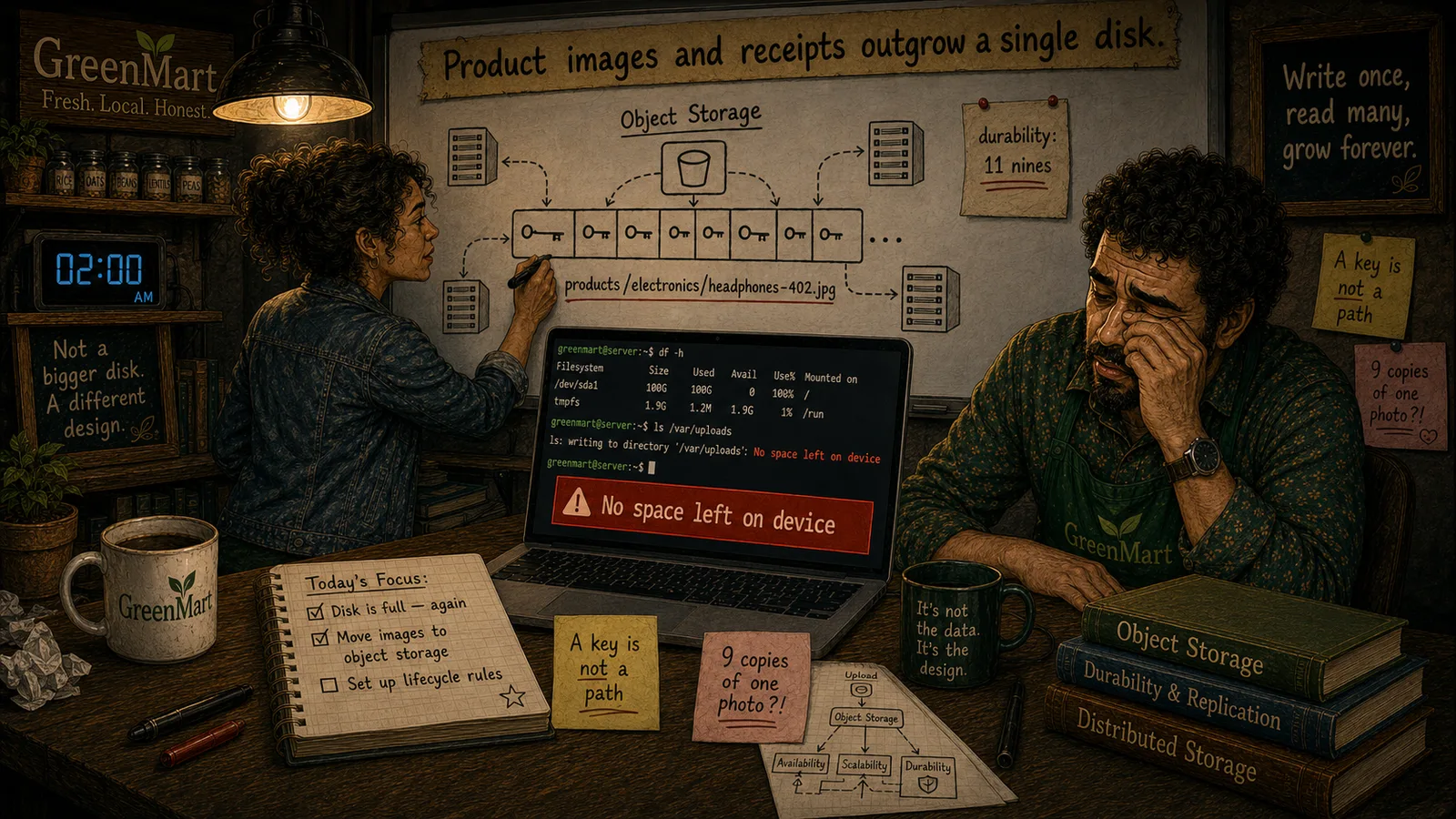
Mike notices a real, specific number on the object storage pricing page: "99.999999999% durability." He counts the nines twice. "Is that a real, meaningful number, or just marketing?"
Sarah smiles. "It's real — and it means something genuinely specific about how many real copies of GreenMart's data actually exist, right now, at this very moment."
'Eleven nines of durability' — is that a real, meaningful claim, or just a marketing number?
Mike
One Real Copy vs. Several, Spread Deliberately Apart
Durability is a real, statistical survival claim
A figure like 11 nines is the concrete probability an object survives over time — not a claim about speed or uptime.
Multi-AZ — copies spread by real distance
True durability requires copies in physically separate facilities, not just redundant disks in the same building.
Replication & Durability
Durability, for an object store specifically, is the real, concrete probability that a stored object survives over time without being silently lost or corrupted — and that probability comes directly from how many real, independent copies of it actually exist, and how deliberately those copies are kept apart from each other.
- What "11 nines" is actually claiming. A durability figure like 99.999999999% is a real, statistical claim about the odds of losing a specific object over a given real period — not a claim about uptime or how fast GreenMart can fetch it (that's availability, a genuinely different, related number). It comes from real, deliberate engineering: keeping multiple independent copies, on independent hardware, checked regularly for real, silent corruption (a later chapter's own subject), so the failure of any single copy doesn't threaten the object's real survival at all.
- Multi-AZ — the real, concrete mechanism behind the number. Object storage systems typically keep real copies of GreenMart's data across multiple, physically separate real facilities (often called availability zones) — not just multiple disks in the same building. This is a deliberate, real choice: a single facility can genuinely lose power, flood, or suffer a real hardware failure affecting everything inside it at once, so true durability requires copies separated by real, physical distance, not just redundant disks sitting side by side.
- Why this Act stays narrower than general replication theory. How those real copies actually stay synchronized across machines — the deep mechanics of quorums, consistency models, and failover — is genuinely general distributed-systems theory, already covered in full elsewhere in this course franchise. What matters specifically for GreenMart, here, is the real, practical outcome that theory produces for an object store: a very high, concrete, quantifiable probability that a written object survives, backed by real, physically-separated copies, not the specific coordination protocol underneath making it happen.
- A real, historical honesty worth knowing. Older object storage systems sometimes offered a genuinely weaker real guarantee — a write might not be immediately visible to every subsequent read, for a real, brief window, while copies caught up with each other. Most major object storage systems today have moved to real, strong read-after-write consistency for standard operations — meaning a successful write is genuinely guaranteed visible on the very next real read, which is worth confirming explicitly for whatever system GreenMart actually adopts, rather than assumed.
GreenMart now has the real, concrete meaning behind that eleven-nines number: not a vague marketing claim, but a genuine, statistical outcome of keeping several real, independent, physically-separated copies of every object GreenMart writes.
Key Takeaway
Durability, for an object store, is a real, statistical claim about surviving loss — built from keeping several genuinely independent, physically-separated copies of every object, distinct from availability (how fast it can be fetched) and distinct from the general distributed-systems replication theory that makes multi-copy coordination actually work underneath.
Why This Matters
GreenMart's product images and receipts moving to object storage inherit this real, quantifiable durability guarantee automatically — understanding what it actually claims (and what it deliberately doesn't) is what lets GreenMart trust that number instead of just taking it at face value.
GreenMart now understands durability as a real, concrete outcome of multiple, physically-separated copies — not marketing, and genuinely different from availability. The next chapter turns to what happens when, despite all of this, something still actually goes wrong: storage failure and recovery.