

In this chapter
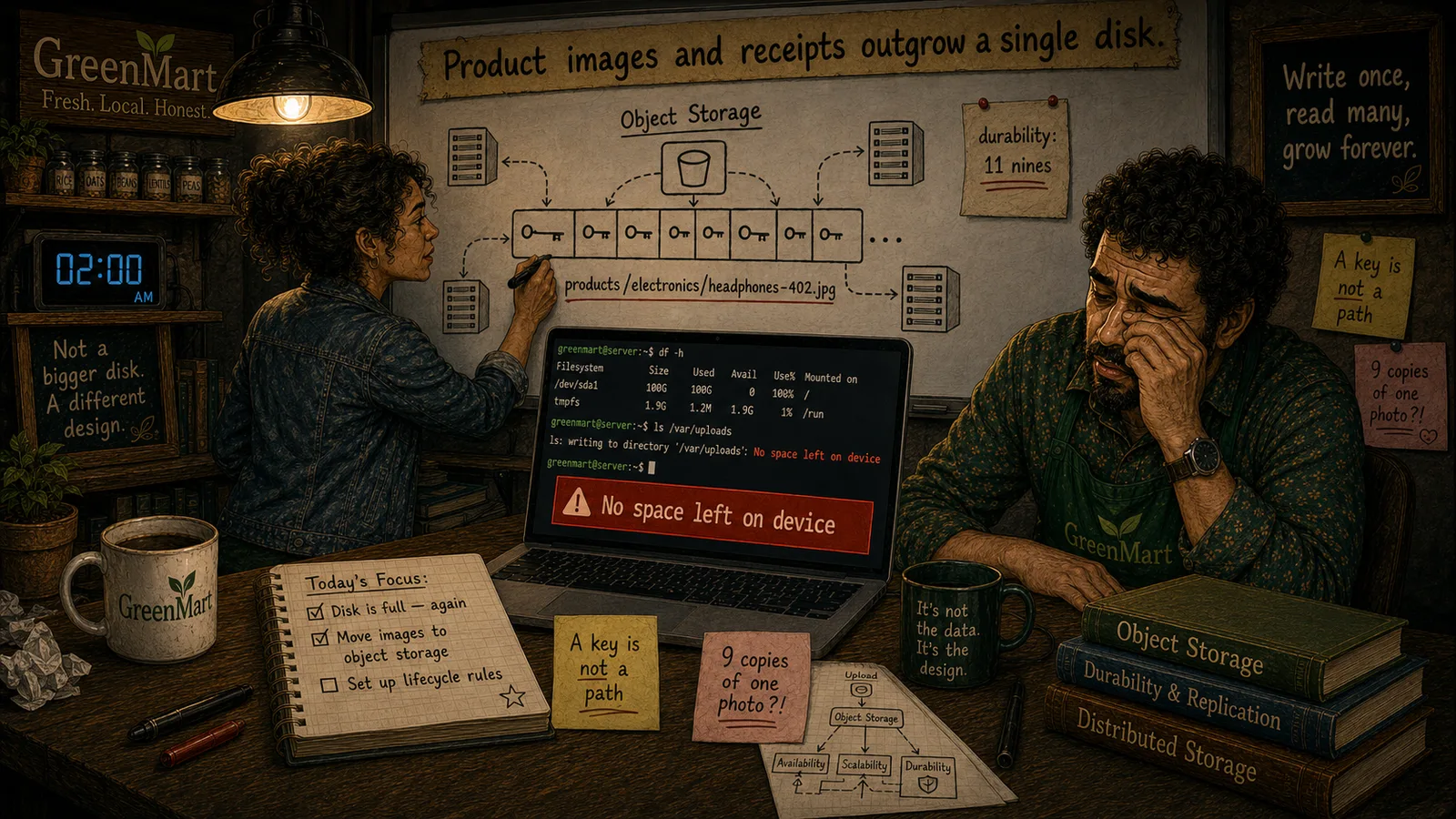
We'll zoom out to see object storage for what it actually is — a real distributed system, spreading data across many independent machines via key-based partitioning — and see how every mechanism this Act covered (replication, checksums, versioning, lifecycle) is real, necessary machinery making that spread work reliably, finally resolving GreenMart's own opening disk-full incident for good.
The Problem in Real Life
Sarah steps back from a whiteboard that's now genuinely full — blocks, objects, buckets, keys, versions, lifecycles, checksums, multiple physically-separated copies. "We started this Act staring at one full disk," she says. "I want to show you what's actually happening underneath everything we just built, so you can see why that disk will never fill up the same way again."
Mike looks at the whiteboard. "So... where does our data actually, physically live now?"
After everything we just built — where does our data actually, physically live?
Mike
One Disk, One Ceiling vs. Many Machines, No Real Ceiling
Partitioning — the real reason there's no ceiling
Keys are spread across many independent machines via hashing — capacity grows by adding machines, not resizing one disk.
Every mechanism, one coherent real system
Keys, replication, checksums, versioning, and lifecycle aren't separate features — they're the real machinery making distribution work.
Distributed Storage Basics
Object storage was never really "a bigger disk." It's a genuinely distributed system — GreenMart's own objects are spread, automatically, across a real, large number of independent machines, and every mechanism this Act has covered is a real piece of how that's made to work invisibly, from GreenMart's own point of view.
- Partitioning — the real reason there's no ceiling. Rather than one volume on one machine (this Act's own opening chapter), an object store real, deliberately spreads its actual data across many independent machines, using a real strategy — commonly, some form of consistent hashing — to decide exactly which machine (or set of machines) is responsible for any given real key. This course's own Act 12 in the previous course already covers consistent hashing's real mechanics in full — the point here is simply this: it's the real reason object storage can keep adding capacity by adding more machines, invisibly, instead of ever hitting one volume's own honest ceiling again.
- Every mechanism from this Act, seen as one real, coherent system. A key (Act 5, chapter 3) is what gets hashed to decide which machines hold it. Multiple physically-separated copies (replication, this Act) exist precisely because those machines are real, independent, and genuinely can fail. Checksums and automatic repair (the last chapter) exist because those many real machines, running for real time, will genuinely experience real, physical degradation somewhere, eventually. Nothing in this Act was ever a separate feature — it's all real, necessary machinery for making "store this object somewhere across a genuinely large number of independent machines" actually, reliably work.
- Why this is deliberately not a second pass at general distributed-systems theory. The deep, real mechanics of coordinating many machines — consistency models, quorums, leader election, handling a real network partition — are genuinely general distributed-systems theory, already covered in full elsewhere in this course franchise. What this Act adds isn't that theory again; it's the specific, real, practical shape that theory takes for an object store specifically: a flat key space, spread by hashing, held durably by physically-separated copies, kept honest by ongoing checksum verification.
- GreenMart's own, real, final answer. The disk that filled up at 2 AM will never fill up the same way again — not because any one disk got bigger, but because GreenMart's product images and receipts no longer live on any one disk at all. They live across a real, large, and growing number of independent machines, addressed by a flat key, replicated for real durability, and verified continuously for silent corruption — genuinely, structurally unbounded, in a way a single volume, however large, could never actually be.
GreenMart closes this Act having done, for real, what the opening chapter only diagnosed: turned "our disk is full" into a specific, deliberate architecture — not a bigger disk, but a genuinely different, distributed real system, built precisely for data that keeps growing without a real ceiling.
Key Takeaway
Object storage isn't a bigger disk — it's a real, distributed system, spreading data across many independent machines via key-based partitioning, and every mechanism this Act covered (replication, checksums, versioning, lifecycle) is real, necessary machinery for making that spread work reliably, invisibly, from GreenMart's own point of view.
Why This Matters
Understanding object storage as a genuine distributed system — not a magic bigger disk — is what lets GreenMart reason correctly about its real, honest limits (a key is a flat lookup, not a real folder; a durability figure is statistical, not a guarantee of zero risk) instead of treating it as an unlimited, unconditional fix.
GreenMart closes Act 5 with the disk-full incident fully, structurally resolved, and a real understanding of why object storage actually scales the way it does. Act 6 turns to a different real question entirely: how does data actually get laid out on disk, underneath every database GreenMart has used across this whole course?