

In this chapter
We'll open up block storage — the real, raw foundation of volumes, partitions, and virtual disks every server (including GreenMart's own) is actually built on — and find the real, honest ceiling behind GreenMart's 2 AM disk-full incident: a single volume, however resizable, was never built to hold an unbounded pile of growing data forever.
The Problem in Real Life
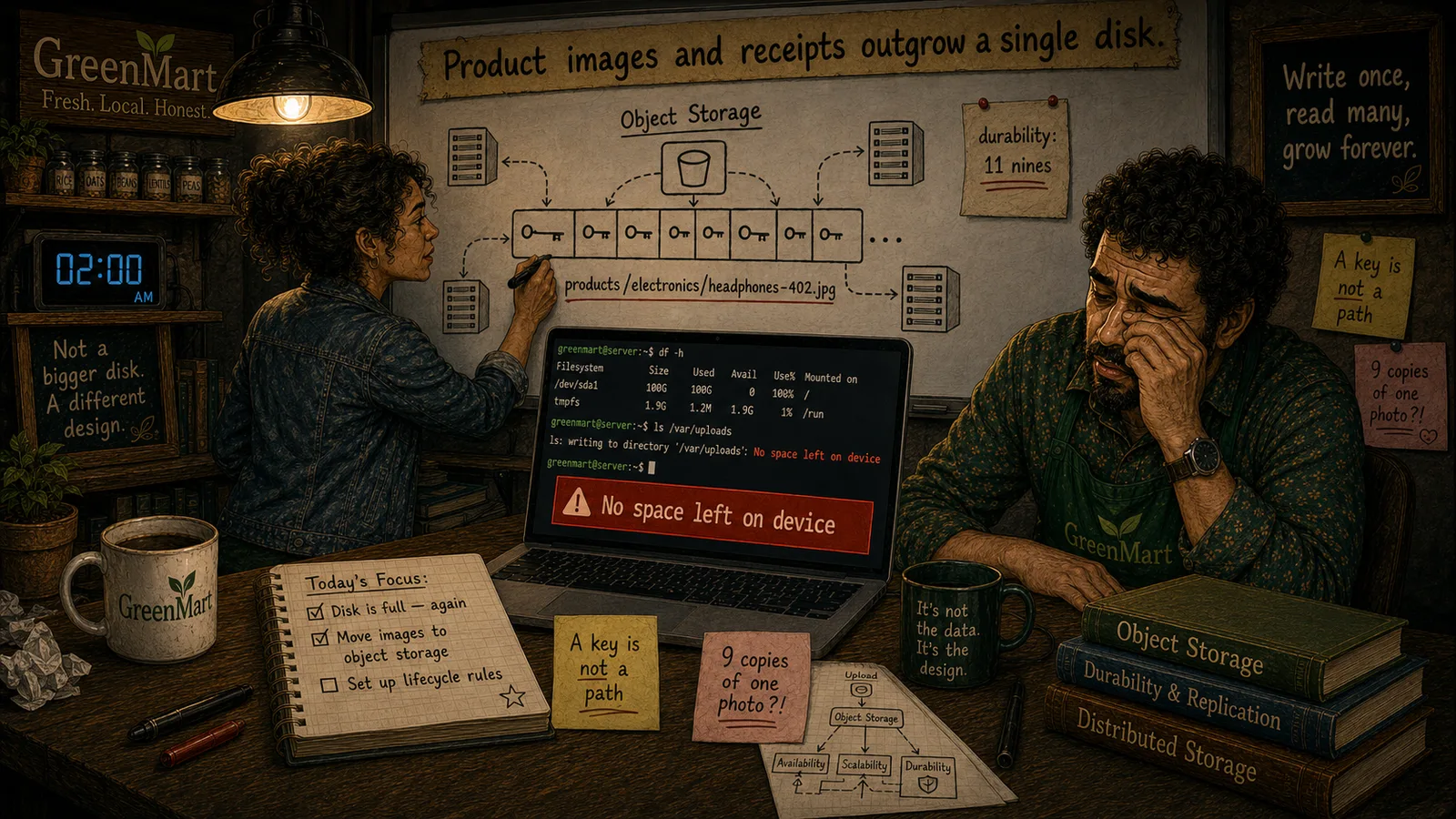
A deploy fails at 2 AM. The error: No space left on device. Mike checks — the app server's disk is at 100%, and most of it is product images and years of customer receipts. "Just attach a bigger disk," he says. "Isn't that the whole fix?"
Sarah pulls up the server's storage. "It'll buy us time," she says. "But I want you to actually see what we'd be resizing, first — because this isn't the last time we'll hit this wall."
Can't we just attach a bigger disk and move on?
Mike
A Disk You Resize vs. A Ceiling You Eventually Hit
Raw, numbered blocks — no idea of files at all
A block device is just a flat sequence of fixed-size blocks — a file system is the real software layer built on top of it.
Resizable, but with a real, honest ceiling
A single volume can grow, but it's still fundamentally one disk, tied to one server's own real, limited use.
Block Storage
Block storage is the real, foundational shape of storage every server, including GreenMart's own, is actually built on — raw, fixed-size blocks, addressed by number, with no built-in idea of files or folders at all. Every file system this course has covered (Act 3) is real software built on top of exactly this.
- What a block device actually is. A block device presents storage as a real, flat sequence of fixed-size blocks — commonly 512 bytes or 4KB each — each one addressable purely by its number, nothing more. It has no real concept of a file, a name, or a directory; a file system (Act 3's own subject) is the real software layer built on top, turning that raw numbered sequence into the organized, named storage Mike actually interacts with day to day.
- Volumes, partitions, and virtual disks — three real, related terms. A volume is a real, usable chunk of block storage, formatted with a file system and ready to be mounted. A partition is a real, deliberate division of one physical (or virtual) disk into multiple separate, independently-formattable regions — useful for keeping, say, the operating system and application data genuinely separate on the same underlying hardware. A virtual disk is what most of GreenMart's own servers actually use today: block storage provided over a network by cloud infrastructure, behaving exactly like a real physical disk to the operating system, even though the real bytes live on entirely separate, dedicated storage hardware elsewhere.
- Local vs. network block storage — a real, honest trade-off. Local block storage — a disk physically inside the same machine — is genuinely fast, with no network hop involved, but it's tied to that one machine's own real, physical lifecycle: if the machine fails, the disk (and everything on it) can fail with it. Network block storage — GreenMart's own virtual disks — trades a small, real amount of latency for genuine independence from any one physical machine, which is exactly why resizing or even reattaching one to a brand-new server, without losing any data, is realistically possible at all.
- Why Mike's "just resize it" isn't actually wrong — yet. A block volume genuinely can be resized, often without downtime, which is a real, legitimate short-term fix. But it has a real, honest ceiling: a single volume still fundamentally behaves like one disk, attached to one server, with a real maximum size and a real limit to how many servers can even use it usefully at once. GreenMart's product images and receipts aren't shrinking, and resizing a single volume repeatedly is a real, temporary patch, not a lasting architecture — exactly the wall the rest of this Act exists to get GreenMart past.
GreenMart now has the real, honest floor everything else in this Act builds on: block storage is genuinely necessary — every server needs it — but a single volume, resized again and again, was never built to hold an unbounded, ever-growing pile of product images and receipts forever.
Key Takeaway
Block storage is the real, raw foundation every file system is built on — genuinely necessary, resizable, and honestly finite in a way that makes it the wrong long-term home for data that keeps growing without a real ceiling in sight.
Why This Matters
Every server GreenMart runs — the database, the app server, this exact one hitting No space left on device — depends on real block storage underneath it. Understanding its real shape and its honest limits is what tells GreenMart exactly when resizing stops being a real fix and starts being a delay.
GreenMart now understands block storage as the real, necessary foundation with a real, honest ceiling — resizable, but still fundamentally one volume, tied to one server's own real use. The next chapter meets the real alternative built specifically for data like GreenMart's own product images and receipts: object storage.