

In this chapter
We'll see why Mike's notebook is failing — and why data without structure is just noise.
The Problem in Real Life
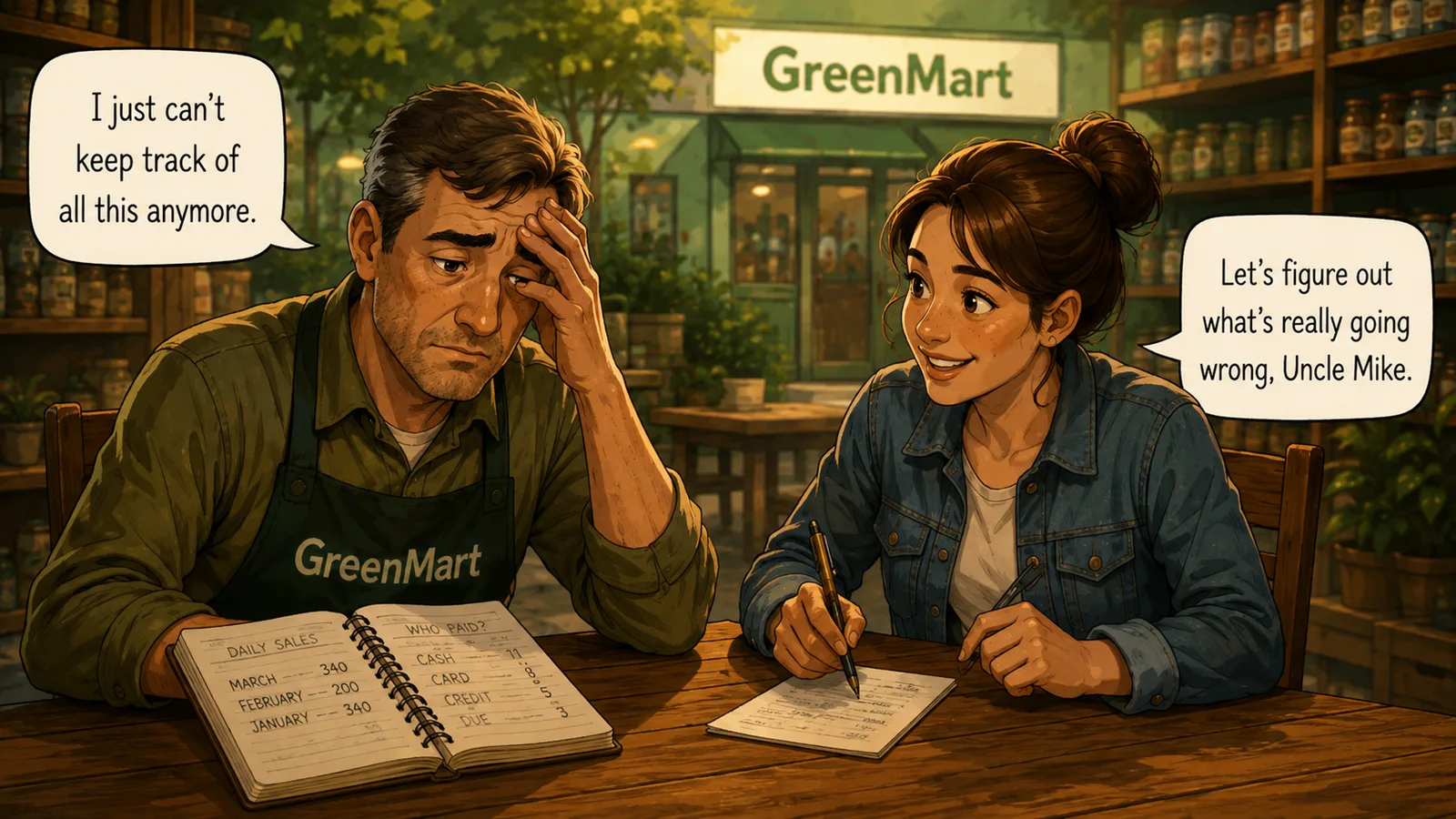
Every evening, Mike closes GreenMart the same way. Mike pulls out a notebook and writes down the day — today's sales, who paid, who didn't, what Sarah restocked. This has worked for years. But it's about to fall apart.
A regular customer walks in and asks a simple question.
How much do I still owe you?
Mike
Notebook vs. Data
Hard to find
Flipping through pages to find one number takes forever.
Easy to get wrong
Crossed-out entries, duplicate notes, missed updates.
Not trustworthy
No way to know which entry is actually true right now.
Can't answer real questions
"How much did we sell last week?" — no easy way to find out.
What Is Data, Really?
Mike flips back through old pages — March, February, a coffee stain over January. Three different numbers show up for the same thing, on three different days. None of them match. Nobody wrote down which one was right.
This isn't really a notebook problem. It's a data problem. And it helps to be clear about what "data" actually means — everything from here on depends on getting that right.
Everything Mike wrote down is data — a fact, recorded somewhere. "Priya, 340" is data. "Priya paid 200" is data too. But a number like "340" means nothing by itself. It only becomes useful once something tells you:
- What it's a fact about
- When it was true
- Whether it's still true right now
Mike's notebook has plenty of data in it. What it's missing is a reliable way to say which piece of data is true right now.
That's the real problem a database solves. Not "where do I write things down" — but "how do I keep facts organized, so months later they still mean exactly what they meant the day I wrote them."
Key Takeaway
Data means nothing by itself. It only means something once it has structure and context.
Why This Matters
This whole course is really one long answer to the question Mike just ran into: how do you keep a fact trustworthy after the moment you wrote it down? A notebook has no good answer to that. It's not Mike's fault — a notebook just isn't built for it. That's exactly the problem Sarah is about to solve.
GreenMart doesn't have a bad notebook. It has simply outgrown what a notebook can do. The next chapter is where that starts to change.